
–
The VxRail Exit Options
Dell’s VxRail product line is losing strategic importance, urging customers to explore exit options. Four paths are available: maintaining the status quo, migrating hypervisors with storage replacement, transitioning to Dell Private Cloud, or adopting a private cloud OS like VergeOS. Each option has implications for costs, migration complexity, and operational efficiency. Organizations must evaluate based…
Read More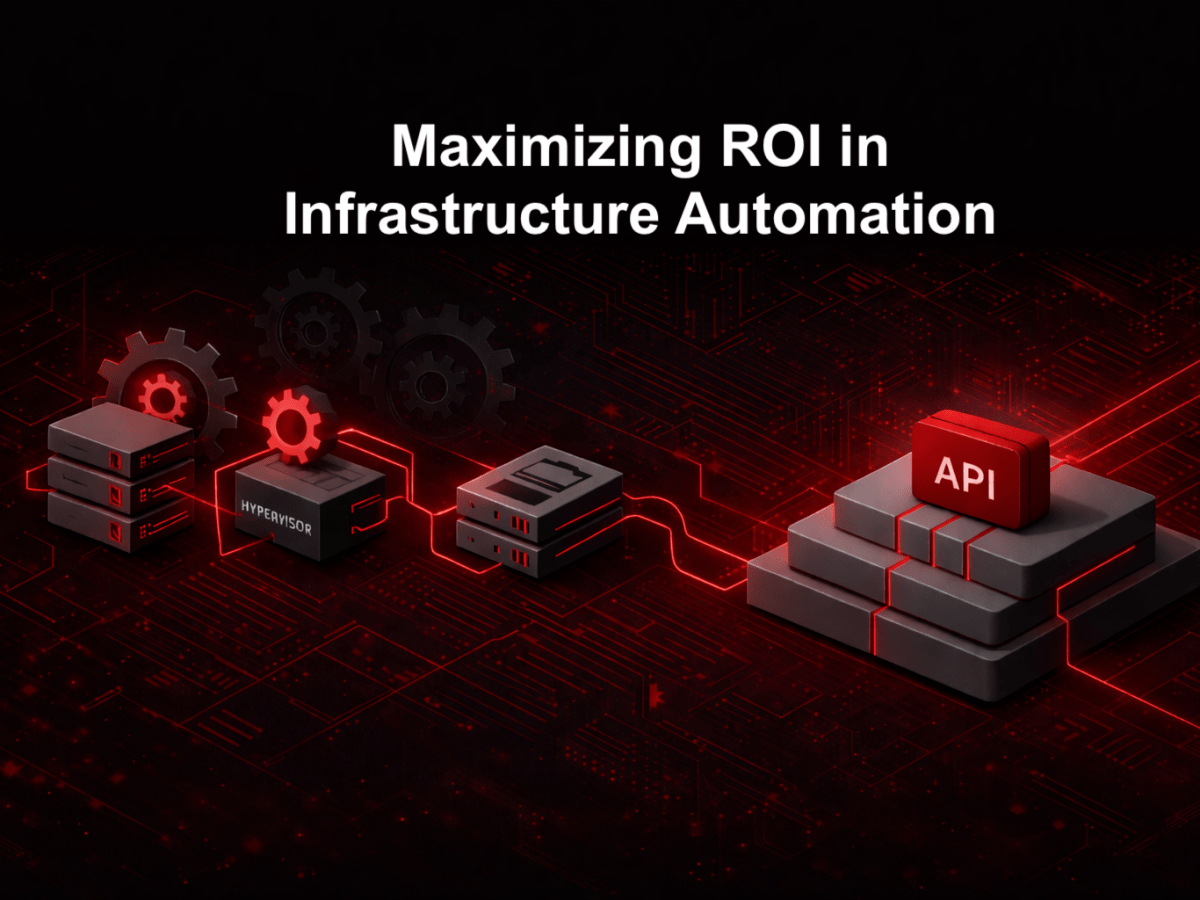
Maximizing ROI in Infrastructure Automation
Infrastructure automation ROI disappoints when organizations spend more time maintaining automation than they save through it. Hardware refresh cycles, storage updates, and network changes force constant code rewrites on fragmented infrastructure. Unified infrastructure platforms eliminate the maintenance burden by leveraging architectural abstraction, preserving automation investments across hardware generations.
Read More
Why Data Protection Automation Fails
Data protection automation fails because it spans four independent layers—storage snapshots, hypervisor snapshots, backup software, and replication systems—each requiring separate APIs. Unified infrastructure platforms eliminate this complexity through single-API integration, making automation maintainable.
Read More
Dashboard Defined VMware Alternatives
Evaluating VMware alternatives? Learn why dashboard-defined VMware Alternatives mask complexity while architecturally unified systems reduce it. Compare approaches.
Read More
Create Private AI With Existing Servers
Artificial intelligence is now central to IT strategy, yet many organizations assume that meaningful progress requires new infrastructure. The assumption comes from the demands of AI workloads. They require substantial CPU and GPU power, high-throughput storage, and fast data movement. Vendors reinforce this belief by offering AI layers that sit on top of existing stacks,…
Read More
All Immutable Storage Does Not Equal Ransomware Protection
Ransomware continues to be one of IT’s biggest challenges, driving organizations to look for better ways to protect their data and accelerate recovery. One of the most common and effective countermeasures is immutable storage — the ability to lock data so it cannot be changed, deleted, or encrypted by an attacker. However, not all immutable…
Read More
VMware Exit: Why DR Readiness Matters More Than the Hypervisor
Most organizations planning their VMware Exit view it as a hypervisor replacement project. That narrow goal hides a larger opportunity: the chance to modernize data protection and recovery. The migration process highlights the failure of legacy disaster recovery strategies to keep pace with modern infrastructure requirements. For many IT teams, the VMware Exit is the…
Read More
Reimagining VDI: The Impact of VMware Exit
A VMware exit presents an opportunity for IT leaders to reassess virtual desktop infrastructure (VDI) and infrastructure strategy as costs decrease and new compliance and security pressures arise. Embracing an infrastructure-wide consolidation can simplify operations, reduce costs, and enhance readiness for AI, transforming complex systems into a unified architecture.
Read More
Why Cloud Repatriation is Critical Post-VMware Exit
83% of enterprise CIOs are now planning to bring workloads back on-premises—nearly doubling from 43% in late 2020. This dramatic shift toward cloud repatriation intersects perfectly with the current VMware migration crisis, creating an unprecedented opportunity for comprehensive infrastructure consolidation. The timing isn’t coincidental, and the economic case is compelling.
Read More
Leveraging Hardware Diversity for Multi-Site IT Efficiency
Multi-site IT succeeds when hardware diversity meets software consistency—delivering flexibility, predictability, and simplicity across Edge, ROBO, Venues, and the core with VergeOS Virtual Data Centers.
Read More


 StorageSwiss.com - The Home of Storage Switzerland