
Cloud Storage
 Rising Cloud Costs: The Case for Owning Hardware in 2026 - Rising cloud costs are changing the economics of infrastructure. As component prices climb and cloud capacity tightens, moving workloads to the cloud no longer provides an easy escape from hardware inflation. Extending server life, using quality second-life enterprise hardware, and choosing an infrastructure platform that preserves hardware freedom can turn ownership into a significant cost and availability advantage.
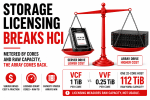 Storage Licensing Breaks HCI - A drive costs a fraction inside a server of what the same NAND costs inside an array. Storage licensing reverses that math, and the array comes back. Hyperconverged infrastructure made a hardware argument and won it. Put the data on…
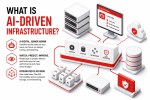 What Is AI-Driven Infrastructure? - AI-Driven Infrastructure gives IT a digital junior admin that clears routine work and frees senior staff to design and scale, with the administrator always in control.
 VMware Alternative Near-Future Requirements - The VMware alternative near-future requirements go beyond reducing licensing costs. Organizations need a platform that supports future workloads while maximizing the value of existing infrastructure, letting new technology and existing hardware coexist and lowering refresh costs.
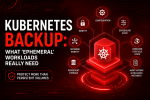 Kubernetes Backup: What ‘Ephemeral’ Workloads Really Need - Developers describe containers as ephemeral. Infrastructure teams who carry that assumption into their Kubernetes backup strategy assume there is nothing to protect. The pod is disposable. The workload is not. Six layers of state live inside the Kubernetes API, survive every pod restart, and disappear entirely when the cluster fails.
 Why Kubernetes Persistent Storage is Harder Than It Should Be - Kubernetes persistent storage is not a provisioning problem. It is an architectural coordination problem. CSI standardized how storage plugs into Kubernetes but did not eliminate operational fragmentation between the storage system, snapshot tool, backup product, and DR layer. The fix is structural. Collapsing storage, virtualization, and Kubernetes integration into one control plane removes the integration tax assembled architectures keep paying.
 Hypervisor Deduplication: The Hidden Tax - Hypervisor deduplication has a storage efficiency problem that most buyers don’t discover until after deployment. For years, the overhead it creates was hiding in plain sight — organizations focused on RAM consumption, licensing costs, and hardware compatibility while storage overhead…
 oVirt: The Standard That Closes the Backup Gap - Every new hypervisor platform claims enterprise readiness. The oVirt API is how backup vendors verify that claim. The VMware alternative market has a fragmentation problem. Dozens of KVM-based platforms now compete for enterprise workloads. Each one ships its own management…
 Bridging the Gaps in AI Production Infrastructure - AI prototypes fail in production not from model or data problems, but from five infrastructure gaps that IT teams have solved for CPU workloads but not yet addressed for GPU-based AI. Learn what AI production infrastructure requires and how virtual data centers close the gap.
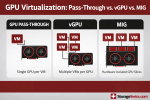 GPU Virtualization: Choosing Between Pass-Through, vGPU, and MIG - GPU virtualization takes three forms: pass-through, vGPU, and MIG. Learn which fits your workload, what each approach costs in performance or flexibility, and how VergeOS unifies all three from a single private cloud platform.


Very Good articles about cloud storage