
Cloud Storage
 oVirt: The Standard That Closes the Backup Gap - Every new hypervisor platform claims enterprise readiness. The oVirt API is how backup vendors verify that claim. The VMware alternative market has a fragmentation problem. Dozens of KVM-based platforms now compete for enterprise workloads. Each one ships its own management…
 Bridging the Gaps in AI Production Infrastructure - AI prototypes fail in production not from model or data problems, but from five infrastructure gaps that IT teams have solved for CPU workloads but not yet addressed for GPU-based AI. Learn what AI production infrastructure requires and how virtual data centers close the gap.
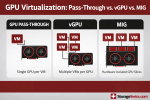 GPU Virtualization: Choosing Between Pass-Through, vGPU, and MIG - GPU virtualization takes three forms: pass-through, vGPU, and MIG. Learn which fits your workload, what each approach costs in performance or flexibility, and how VergeOS unifies all three from a single private cloud platform.
 Navigating Rising Storage Costs: Stick with N+2 Protection - Rising flash costs tempt IT planners to reduce N+2 data availability to N+1. That logic is wrong. AI is driving both the price increases and the growing value of your data. The answer is not less protection. It is smarter protection through triple mirrors, repair servers, and commodity drives.
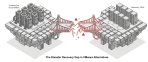 VMware Alternatives: Ensuring Disaster Recovery Readiness - Organizations evaluating VMware alternatives focus on licensing costs, migration complexity, and feature parity. Disaster recovery rarely makes the shortlist, and that oversight can prove expensive. If the alternative cannot recover from a disaster efficiently, the cost of downtime and data…
 The Economic Shift Supporting Private Cloud Adoption - VMware licensing costs and component prices surge while server supply tightens. Private cloud failed before because orchestrated stacks masked complexity rather than eliminating it. Technology maturity and economic pressure now make integrated private cloud platforms operationally essential and economically viable.
 The VxRail Exit Options - Dell's VxRail product line is losing strategic importance, urging customers to explore exit options. Four paths are available: maintaining the status quo, migrating hypervisors with storage replacement, transitioning to Dell Private Cloud, or adopting a private cloud OS like VergeOS. Each option has implications for costs, migration complexity, and operational efficiency. Organizations must evaluate based on infrastructure preservation, execution risk, and simplification post-transition. Delaying decisions may limit future choices as hardware ages and support contracts expire.
 Maximizing ROI in Infrastructure Automation - Infrastructure automation ROI disappoints when organizations spend more time maintaining automation than they save through it. Hardware refresh cycles, storage updates, and network changes force constant code rewrites on fragmented infrastructure. Unified infrastructure platforms eliminate the maintenance burden by leveraging architectural abstraction, preserving automation investments across hardware generations.
 Reimagining VDI: The Impact of VMware Exit - A VMware exit presents an opportunity for IT leaders to reassess virtual desktop infrastructure (VDI) and infrastructure strategy as costs decrease and new compliance and security pressures arise. Embracing an infrastructure-wide consolidation can simplify operations, reduce costs, and enhance readiness for AI, transforming complex systems into a unified architecture.
 Why Cloud Repatriation is Critical Post-VMware Exit - 83% of enterprise CIOs are now planning to bring workloads back on-premises—nearly doubling from 43% in late 2020. This dramatic shift toward cloud repatriation intersects perfectly with the current VMware migration crisis, creating an unprecedented opportunity for comprehensive infrastructure consolidation. The timing isn't coincidental, and the economic case is compelling.


 StorageSwiss.com - The Home of Storage Switzerland
Very Good articles about cloud storage