Blog Archives

ChalkTalk Video: Your DR Plan Needs Three Buckets

All applications are not the same but most organization treat them that way. The problem with treating all application equally is it increases the cost of your disaster recovery effort and, in most cases, decreases your ability to meet expectations.

Tagged with: , , , , , , , , ,
Posted in Video

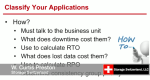
StorageShort: How To Classify Your Applications for DR

Storage Switzerland’s W. Curtis Preston suggests in a recent video the key to a successful DR plan is classifying your applications into recovery buckets or priorities. But how exactly do you determine which applications should go into which bucket? In

Tagged with: , , , , , , , , ,
Posted in StorageShort

How to Get More from All-Flash Using Software Defined Storage

Flash often makes the hardware selection less important, but makes the software selection very important. The right software can not only ensure optimal flash performance, but also extend flash implementation beyond the typical high-transaction database use cases and into modern

Tagged with: , , , , , , , , , ,
Posted in Blog

Is Mutual Mystification Part of your Disaster Recovery Plan?

It is impossible for all applications to be recovered instantly with no data loss after a disaster. But that is exactly what users expect. We find in some organizations IT avoids having the necessary conversation that brings users and application

Tagged with: , , , , , , , , , , ,
Posted in Blog

Do You Understand Your Disaster Recovery Buckets?

Disaster Recovery is a complex and fragile process. That is why it is important for IT to simplify that process as much as possible. An area where we are seeing success is how you group applications. While each application will

Tagged with: , , , , , , , , ,
Posted in Blog

ChalkTalk Video: When Should You Use High Availability instead of Backup?

Most data centers have some sort of backup strategy where it copies data on a periodic basis, typically once per night, to a secondary storage device and then either replicated or transported to a disaster recovery site. They count on

Tagged with: , , , , , , , , , , ,
Posted in Video

Are Instant Recovery and Inline Deduplication Compatible? – Altaro Briefing Note

Is instant recovery compatible with inline deduplication? That’s the question I found myself asking after listening to the briefing for Altaro VM Backup 7, since Altaro announced the addition of both features in this version. I’m a fan of instant

Tagged with: , , , , , ,
Posted in Briefing Note

Can You Eliminate Downtime? – New White Paper

Achieving a zero or near-zero recovery point and recovery time objective requires planning. From a data perspective, IT needs to position the data in a ready state on the recovery system. The positioning or copying of data needs to happen either as,

Tagged with: , , , , , , , , , ,
Posted in Blog

How IT can Leverage its Own Big Data for Operational Efficiency

OpsDataStore Briefing Note One of the most practical use cases of big data analytics is the analysis of data that the organization is already generating, typically in the form of log file examination, which yields impressive results (most notably in

Tagged with: , , , , , , ,
Posted in Blog

Can You “Future Proof” Data Protection?

The data protection process always seems like it is playing catch up to the recovery expectations of production data. Part of the problem is that data protection is often considered after an application has rolled-out in production. The other part

Tagged with: , , , , , , , , ,
Posted in Blog