
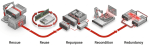
Rising DRAM, NAND, and server costs are forcing a shift in how organizations build and maintain IT infrastructure. Five words will define the next five years: rescue, reuse, repurpose, recondition, and redundancy.
Rising DRAM, NAND, and server costs are forcing a shift in how organizations build and maintain IT infrastructure. Five words will define the next five years: rescue, reuse, repurpose, recondition, and redundancy.
Dell’s VxRail product line is losing strategic importance, urging customers to explore exit options. Four paths are available: maintaining the status quo, migrating hypervisors with storage replacement, transitioning to Dell Private Cloud, or adopting a private cloud OS like VergeOS. Each option has implications for costs, migration complexity, and operational efficiency. Organizations must evaluate based on infrastructure preservation, execution risk, and simplification post-transition. Delaying decisions may limit future choices as hardware ages and support contracts expire.

A VMware exit presents an opportunity for IT leaders to reassess virtual desktop infrastructure (VDI) and infrastructure strategy as costs decrease and new compliance and security pressures arise. Embracing an infrastructure-wide consolidation can simplify operations, reduce costs, and enhance readiness for AI, transforming complex systems into a unified architecture.
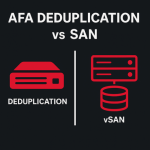
The transition from VMware requires careful consideration of deduplication and storage options. All-Flash Arrays (AFAs) excel in performance but are costly, while vSAN faces latency issues due to its complex architecture. Integrated ultraconverged systems like VergeOS eliminate trade-offs, improving efficiency and reducing costs by unifying deduplication with core hypervisor functions.

Many IT teams searching for a VMware alternative overlook networking costs. Proprietary switches, firewalls, and VPN appliances add unnecessary expenses. By integrating SDN into the hypervisor, organizations can eliminate licensing fees, reduce hardware costs, and simplify management—without sacrificing performance or security. Now is the time to rethink networking.
Explore how combining SAN replacement and VMware exit projects can reduce costs, simplify operations, and future-proof your IT

VMware storage challenges are the limiting factor in how thoroughly organizations adopt it. Both AFA and HCI continue to fall short in addressing VMware storage problems. Learn what these challenges are and how to fix them.

Array-based replication may seem ideal for IT professionals looking to improve their disaster recovery (DR) strategy. It sends an off-host copy of data to a remote site without installing special software in the hypervisor. However, array-based replication is expensive and…

When looking for a VMware alternative, you need to move beyond low prices and look for a solution to minimize VMware TCO triggers. VMware Total Cost of Ownership (TCO) triggers are challenges or needs that come up during the use…

If disaster strikes, the purpose of a disaster recovery plan (DRP) is to guide the available IT personnel through the process of recovering the data center, either at an alternate site owned by the company or a facility owned by…


 StorageSwiss.com - The Home of Storage Switzerland