
Hyper-converged storage is true Software-defined Storage (SDS), since by migrating storage intelligence to the hypervisor it’s completely hardware agnostic. But there’s still room for improvement. In this podcast, we look at how SDS is evolving and how it can continue…
Blog Archives
Software Defined Storage – Podcast
Tagged with: Atlantis ILIO, Backup, Cloud, Cloud computing, Data center, Flash, Flash memory, Hardware, Software Defined Storage, Solid-state drive, SSD, Storage
Posted in Podcast
Posted in Podcast
IBM’s Storage Business Is Not Doomed
The news a couple of weeks ago that IBM had sold its server business to Lenovo set off a flurry of speculation about what IBM would do with the rest of its hardware offerings. While no one outside of IBM…
Tagged with: Commoditization, Flash, IBM, Memory, Non-volatile memory, Software Defined Storage
Posted in Blog
Posted in Blog
Is 10GbE Fast Enough For Flash Storage?

In a recent Storage Switzerland report (commissioned by Brocade and now available for download), we point out that there is a gap between high performance compute and high performance storage — the storage network. Workloads like server and desktop virtualization,…
Tagged with: Brocade, FCoE, Fibre Channel, Flash, Gen 5, performance, Spanning Tree Protocol, Virtualization
Posted in Blog
Posted in Blog
Storage Sprawl – How Flash Let Us Down
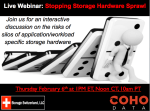
As we discussed in our last column “Why Is Storage Hardware Sprawl Worse Than Ever?”, toward the end of the last decade (2007-2010) the data center began to tap into the abundance of compute power available to it but providing…
Tagged with: All-Flash Array, Coho Data, Flash, Software Defined, Sprawl, SSD, Virtual
Posted in Blog
Posted in Blog
Why Is Storage Hardware Sprawl Worse Than Ever?
Once thought eliminated through storage networking via storage consolidation, storage hardware sprawl is worse than ever. As we discussed in our webinar, “How To Stop Storage Hardware Sprawl“, there are several reasons for this. First, there are more workload types…
Tagged with: Coho Data, Flash, Hybrid, Sprawl, Storage Hardware, Virtualization, Webinar
Posted in Blog
Posted in Blog
Which Is The Right Way To Implement Flash Storage?

During a recent Storage Swiss webinar, we polled our audience about how they were currently using caching technology in their environment. A significant percentage of respondents replied that they were using caching directly on their server infrastructure. This is not…
Proving That All PCIe SSDs Are Not Equal – The Huawei Tecal ES3000

PCIe based flash solutions remain a popular method for accelerating application performance. However, there’s a tendency to treat all these cards the same, which would be a mistake since there are vast differences between these offerings that can lead to…
How to Implement a Risk-free, Network-based Flash Caching Solution

Flash-based data caching is a popular choice for cost effectively improving application performance in many different environments, but where that cache is located is a central part of any decision to use flash caching. Host-based caching (also called “server-side” caching)…
How Do I Know My SQL Server Environment is Ready for SSD?

SQL Databases of almost any size should be a top consideration for SSD integration. Because of the granularity of the database structure small components of the database can be moved to SSD, reducing the overall SSD investment. In this article, Storage Switzerland’s Lead Analyst, George Crump discusses how to determine which of those componets should be on SSD. This report will show that a surprisingly small amount of SSD can provide a cost effective, more scaleable, higher performing database for the entire environment.
Learn:
Which Storage Statistics Can Help You Determine SQL SSD Readiness
Which component of your SQL environment should be on SSD
The ROI of SSD Investment for SQL Environments
IBM Announces Memory Channel Storage

At Storage Switzerland we have been covering the move to memory channel storage for the last six months. It is the next logical upgrade from drive-attached and PCIe-attached flash storage. By putting the flash directly on the memory bus traditional…


 StorageSwiss.com - The Home of Storage Switzerland