

Riverbed Briefing Note Most of the focus in the enterprise is on the data center, but in reality most of the action is in the remote office/branch office (ROBO). ROBO is the new normal for most organizations. It allows them…
Riverbed Briefing Note Most of the focus in the enterprise is on the data center, but in reality most of the action is in the remote office/branch office (ROBO). ROBO is the new normal for most organizations. It allows them…
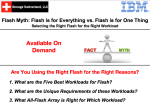
Did you ever hear the old adage that to a hammer everything looks like a nail? This is certainly true in the land of the all flash array. Such arrays are certainly the fastest storage array option available today, and…

Acronis has come a long way since the initial introduction of its backup software many years ago. It now protects over 5 Exabyte of data for over 500,000 business customers and over 5 million consumer customers, 40 percent of whom…

Hyperconvergence has seen significant uptake in the last two years, driven by its simplification of IT infrastructure. It reduces the need to manage discrete devices or have specialized training in component-level technology, such as storage area networks (SANs); makes operations…

For quite some time now, organizations have struggled to keep up with explosive data growth that continues to grow exponentially each year. In addition to the never ending demand for faster application response times, most data now needs to be…

Web-scale applications are designed to run on dozens, if not thousands, of small commodity servers, which expect direct-attached storage. As a result storage performance and capacity is directly tied to the purchase of more compute (servers). Over time almost every…

As modern organizations struggle to keep up with the ever-growing data deluge, they have been forced to deploy and overprovision different types of storage in order to meet their Service Level Agreements (SLA), leading to unprecedented storage sprawl. Storage consolidation…

Have you ever needed to get somewhere really quickly? Consider the things that go through your mind. This parallels how storage management is typically done in today’s data centers. But we could do better. For example, what if you lived…

IT professionals use the phrase “cloud bursting” to describe a process where they move compute and storage to the cloud when the local data center runs out of those resources. But there is another type of bursting that happens to…

Flash storage is fundamentally changing the data center. It is allowing databases to meet the demands of users and virtual infrastructures to achieve new levels of virtual machine (VM) density. But what comes next after flash? Is it another advancement…


 StorageSwiss.com - The Home of Storage Switzerland