

Hybrid VMware should allow an organization to run a virtual machine either on-premises or in the cloud. And that transfer between operating locations should be able to occur at a moment’s notice. The problem is, as we discuss in our…
Hybrid VMware should allow an organization to run a virtual machine either on-premises or in the cloud. And that transfer between operating locations should be able to occur at a moment’s notice. The problem is, as we discuss in our…

Some see the reliance on the public cloud as the Achilles’ heel of enterprise file sync and share (EFSS). While EFSS products are more robust than their consumer-grade counterparts, their use of the cloud does add a number of concerns…
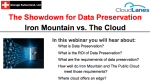
Join Storage Switzerland and CloudLanes for our on demand webinar as we compare Iron Mountain to the cloud and provide ways to solve the gaps in public cloud storage’s ability to be a viable data preservation service. Every organization needs…

Disaster Recovery as a Service (DRaaS) is becoming one of the most popular methods for data centers to not only solidify their disaster recovery strategies, it is all becoming a go to method for general data protection. It provides quick,…

One of the lessons IT is learning from Hurricanes Harvey and Irma is there are some situations where the organization really does not need to meet, or even come close to meeting the strict recovery point and recovery times it…

Users are more mobile than ever and while devices like tablets and smartphones are commonplace, most road warriors get most of their work done on laptops. A lot of the data on these laptops is unique and is never stored…
The problem with the term “data archiving” is it implies a method to store data that hasn’t been accessed in a while and likely will never be accessed again. The of goal of archiving is to reduce costs by moving…

Unstructured data presents two scaling challenges to the data center. The first is capacity. It comes as no surprise to any IT professional that unstructured data is growing at an alarming rate. The second is performance, which may take some…
First it was Ransomware. Now it’s two epic Hurricanes. What’s Next? Listen to our Podcast as Infrascale’s Director of Marketing, Carla Fedrigo joins Storage Switzerland’s Founder and Lead Analyst George Crump on a new podcast, “The State of Data Center…
Most of the time IT spends focusing on disaster recovery planning is actually spent on protection, making sure data is being copied to a secondary storage system and a secondary site either by backup or replication. Some advanced recovery planners…


 StorageSwiss.com - The Home of Storage Switzerland