
Testing the organization’s ability to recover from a disaster is almost as bad as having to go through an actual disaster. As a result, most organization’s don’t have disaster recovery testing as part of its standard workflow. The lack of…
Testing the organization’s ability to recover from a disaster is almost as bad as having to go through an actual disaster. As a result, most organization’s don’t have disaster recovery testing as part of its standard workflow. The lack of…

Disaster recovery planning (DRP) is a long and arduous process. The process of creating and even updating a disaster recovery plan is the primary reason that most plans, if they exist, are woefully out of date. In the event of…
The pace of data center change is also changing disaster recovery. What once was a planned for and a well-documented process is now more of an ad-hoc fire drill. When disaster strikes, IT scrambles to recover everything as fast as…

The single biggest challenge facing backup, ironically has nothing to do with backup. Backup’s biggest challenge is the pace at which the organization evolves and the speed at which it expects IT to keep pace with that evolution. Combine that…
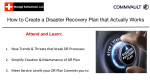
Disaster Recovery plans have always been hard to create and maintain in part because it is difficult to meet the service levels that those plans promise. With recent trends like GDPR and ransomware threats, it is even more difficult for…

In a recent blog, we discussed how scale-up architectures break backup, forcing customers into expensive and disruptive forklift upgrades. Scale-out architectures are the logical solution to the scale-up challenge. But, scale-out architectures create problems of their own. IT planners need…
The next step in all-flash performance is NVMe. Systems equipped with NVMe support promise to increase performance and lower latency. But, IT professionals want to know if their data centers can take advantage of NVMe and how they should plan…

The first step for NVMe flash is to use them internally in servers and storage systems. However, there is another aspect of NVMe, NVMe over Fabrics (NVMe-F) that promises high-speed communication between devices and also promises a new way to…

Quantum Xcellis Scale-out NAS Briefing Note Unstructured data is polarizing. On one end, a large portion of unstructured data needs almost no performance, it just needs to be retained in case it is needed in the future. On the other…

Data center modernization usually includes the organization moving to modern cloud applications like MongoDB, Cassandra and Hadoop. Like most new initiatives a forgotten element is data protection. These environments are particularly challenging to protect because they are designed to run…


 StorageSwiss.com - The Home of Storage Switzerland