

A lot of the advancements happening in storage seem to be for unstructured data. Why is that? Have all of the problems for databases been solved? It’s not like databases are no longer important. But what does seem to be…
A lot of the advancements happening in storage seem to be for unstructured data. Why is that? Have all of the problems for databases been solved? It’s not like databases are no longer important. But what does seem to be…

Many years ago when the NAS market was born, it was very simple to distinguish between NAS systems and SAN systems. SAN systems ran on Fibre Channel and NAS systems ran on Ethernet. SAN systems used block protocols like SCSI…

Eighty percent of an organization’s data is active and 15% of it really matters. Archiving is the management of the 80%. Data preservation is the management 15%. While organizations often need help identifying the 80% of data that is not…
Typically IT has to perform a data migration from an old storage system to a new one every few years. The old system has either come off of maintenance, is out of capacity, or can’t deliver the performance the organization…

Most organizations have a subset of data they need to preserve. Preservation is different than archiving. Preservation means that the data can’t be changed, must always be readable and the organization needs to know who is accessing it. Often there…

It’s time to retire Network Attached Storage (NAS) – at least as we know it. These systems, glorified file servers, are over two decades old. In that time, users have become more mobile, and organizations more diverse. What seemed like…

An organization’s backup storage target options have changed from simple tape to an almost bewildering number of options such as fully integrated backup appliances, secondary storage systems, cloud storage, object storage and various other software defined storage (SDS) systems. An…
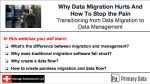
In response to a polling question in our recent webinar, “Why Data Migration Hurts And How To Stop the Pain,” 27 percent of the respondents indicated their biggest challenge was integrating on-premises storage with the cloud. While general data migration…
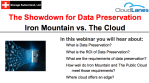
Join Storage Switzerland and CloudLanes for our on demand webinar as we compare Iron Mountain to the cloud and provide ways to solve the gaps in public cloud storage’s ability to be a viable data preservation service. Register today and…

Small to medium sized businesses (SMBs) often lack a good backup and recovery strategy, and often do not realize the difference between archive and disaster recovery. They find quality data protection (DP), data retention and disaster recovery difficult to obtain…


 StorageSwiss.com - The Home of Storage Switzerland