
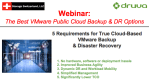
VMware specific backup solutions have been around for years, and most of them have added some form of cloud connectivity to their feature set. But, most of these options simply use the cloud as a digital dumping ground and don’t…
VMware specific backup solutions have been around for years, and most of them have added some form of cloud connectivity to their feature set. But, most of these options simply use the cloud as a digital dumping ground and don’t…

Almost every data center needs to test operating system updates and new code releases. A DRaaS solution can meet the need. The problem is these testing needs require a copy of the server being tested with a most recent copy…

Public cloud storage is highly scalable and very cost effective. It also happens to be located next to an almost infinite supply of compute. Why then do most primary storage vendors pretend the resource doesn’t exist? The answer is quite…
Most data growth in the enterprise is happening because of secondary storage use cases like backup, archive, and data re-use for test/dev or analytics (also known as copy data). In most cases, the capacity of secondary data is 10 to…

Cloud adjacent storage is storage positioned within close proximity to a data center owned by a cloud provider. It enables compute the cloud provider hosts to have high performance, low latent access to data across traditional storage protocols. The challenge…

Converging compute, storage and networking into a single tier sounds good at first but as the architecture scales and tries to extend into the cloud, problems arise. Most hyperconverged infrastructures are “over-converged.” In most cases, the lowest common denominator is…

Cloud backup has several advantages over traditional on-site backup and one big negative; the data is no longer stored within the familiar confines of the data center. Even if the cloud backup solution provides robust encryption, many organizations have some…

Disaster Recovery as a Service (DRaaS) is a great way for an organization to start its cloud journey, and the first part of that journey starts with a backup. Data has to get to the cloud before it can be…

Disaster Recovery as a Service (DRaaS) solves a lot of problems for IT professionals trying to prepare their organizations to survive a disaster. At the same time, though, it also creates new challenges that need to be resolved prior to…

Disaster Recovery as a Service (DRaaS) solutions have vaulted to the top of the considerations list for organizations looking to improve their ability to recover from major disasters like hurricanes and floods. But DRaaS solutions are not just for recovery…


 StorageSwiss.com - The Home of Storage Switzerland