

IT professionals have more choices than ever to sort through as they try to make a storage decision. From a hardware perspective should they continue to use hard disks or should they start to move toward an all-flash data center?…
IT professionals have more choices than ever to sort through as they try to make a storage decision. From a hardware perspective should they continue to use hard disks or should they start to move toward an all-flash data center?…
Initiatives like server virtualization, cloud infrastructure-as-a-service, and real-time analytics are allowing IT to meet today’s ever-increasing business demands. These initiatives are designed to bring agility to the data center, yet they trip and fall when they have to interact with…
High-Performance Compute (HPC) and the storage infrastructure that supports it has long been considered a realm unto itself. Enterprise IT would have nothing to do with it. However, in the past decade, massive I/O bottlenecks have emerged throughout IT infrastructure…

Which is Right for Windows Applications? Virtualization has allowed the data center to become more responsive to the needs of the business. As it has moved into production, however, virtualization has hit several walls and the scalability of the “one…
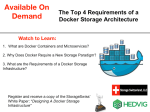
Like virtualization before it, container technology will evolve from a DevOps initiative to an enterprise requirement. Docker is leading that evolution as it promises to bring greater efficiency to the data center than we ever thought possible with the virtual…

Infinio CEO Arun Agarwal sits down with Storage Switzerland’s George Crump and Charlie Hodges to talk about Infinio and how he’s trained his entire work life to run a start-up technology company. Infinio brings to market a fundamentally new architecture to…

Briefing Note: Komprise Data Management Solution As anyone who has been in IT for a while knows, modern organizations are swamped by what has been called a “tsunami of data.” Various industry sources have indicated that data is more than…
In the perfect world, a data center would have a single storage system. One that would provide high performance and high capacity in a single platform that doesn’t take up much data center floor space. Ideally, this system would be…
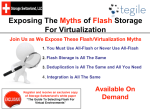
Flash storage has become the cure-all for the storage I/O blender created by the virtual server and virtual desktop environment. But the rush to flash has created a few myths about how to use flash for virtualization. In this webinar…

At Storage Switzerland we write a lot about storage consolidation. While consolidation can simplify management the initial requirement of refreshing and potentially replacing legacy storage is a show stopper for many data centers. SDS provides a viable alternative if it can be used on existing storage assets so that the management and operation of those devices can be consolidated. In this article we discuss how SDS can provide simplification while being more cost-effective.


 StorageSwiss.com - The Home of Storage Switzerland