

Scaling is a capability that almost every vendor claims but few execute well. Most vendors claim to provide scalability via a scale-out storage system, but scale-out by itself is not enough to address all the scaling demands of a Commercial…
Scaling is a capability that almost every vendor claims but few execute well. Most vendors claim to provide scalability via a scale-out storage system, but scale-out by itself is not enough to address all the scaling demands of a Commercial…

The European Union’s General Data Protection Regulation (GDPR) deadline for implementation has come and gone. Many organizations have achieved a basic level of compliance, so now is the time to dig deeper, tie up loose ends and try to simplify…

Selecting a cloud backup solution also means selecting a cloud provider. For enterprises, cloud provider options range from the megacloud providers like Amazon AWS, Microsoft Azure and Google Cloud to small regional providers. Another decision for enterprises is in selecting…

If ransomware gets through an organization’s defenses, they have two choices. Recover or pay. Given the growth in the number of ransomware attacks, many organizations choose to pay, which only further fuels the industry making the next round of ransomware…
One of the significant challenges regarding data protection is managing its data set. Secondary storage tiers store five to ten times as much data as production data stores and can overwhelm the data center. IT planners are looking to cloud…
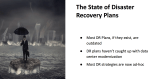
Disaster Recovery Plans (DRP) are supposed to be an organization’s playbook if they need to recover critical data center operations after a disaster. The issue is that in most organizations, the DRP is outdated if it exists at all. Disaster…
When core IT receives a new workload, application owners tell IT what storage resources the workload needs as it enters production and what the expected resources are when it matures. Core IT then has to look at its available storage…

Backup, archive and managing secondary storage capacities are a constant thorn in IT’s side. Backup is often a disaggregated mess, and IT doesn’t have time to implement archiving. Secondary storage capacities, thanks to initiatives like IoT and next-generation applications, threaten…

Analytics is evolving from big data, machine learning to artificial intelligence. Machine learning is the analysis of data at rest, artificial intelligence (AI) is the analysis of data in real-time. Machine learning is predictive; AI is cognitive. The requirements of…

The one constant in the modern data center is scale. IT professionals are continuously under pressure to add additional servers, virtual machines and containers. With those additions comes the demand for more storage capacity and more storage performance. The storage…


 StorageSwiss.com - The Home of Storage Switzerland