

Meeting a strict recovery point and recovery time objective requires more frequent backups and the ability to recover without transferring data. In this 74 second video we tell you how to meet strict RPO/RTOs. For more details watch our on-demand…
Meeting a strict recovery point and recovery time objective requires more frequent backups and the ability to recover without transferring data. In this 74 second video we tell you how to meet strict RPO/RTOs. For more details watch our on-demand…
The worst case recovery scenario is failure of your storage system, not destruction of the data center. If your data center is destroyed, you can at least point to where it used to be and most users will understand the…
Traditional backup processes were developed for local backup systems, not the cloud, and so were not designed to minimize the time required to complete backup jobs over a WAN. Most cloud backup solutions leverage this same technology, storing data locally…

Backup 2.0 Workshop On The Way To London We completed Backup 2.0 Dallas and we will be in London on October 22nd. A popular session during the workshop discusses leveraging secondary storage and creating a usable copy of data that is only a…
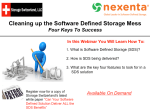
Is Software Defined Storage (SDS) getting hijacked? It seems every vendor, old and new, is claiming that their storage is “software defined”. In our on demand webinar listen as experts from Storage Switzerland and Nexenta provide guidance to sorting out…
The Recovery Gap Storage Switzerland’s latest webinar, now available on demand, discussed ways that IT professionals could create the “Always-on Data Center”. In that webinar we asked a polling question that had surprising results. Over 89% of the attendees could…
Seagate CSS (Cloud Systems and Solutions), a division of this long-time disk drive manufacturer, was put together to develop storage infrastructure solutions for the hyper-scale cloud provider and OEM markets, among others. More than just a component manufacturer ‘moving up…
There are a number of ways to implement SDS, including as a software-only solution. This method allows the user to provide the hardware, even re-purposing existing equipment in some cases. There are a number of user benefits to leveraging SDS…
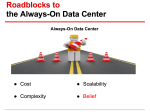
Believing in the Always-On Data Center One of the topics in our on demand webinar, “Making The Always-On Data Center A Reality”, is overcoming the roadblocks to the Always-On Data Center. In this webinar experts from Storage Switzerland, Veeam and…

Unlike cloud compute which can scale up and down on the fly, cloud storage is more permanent. While organizations that use cloud storage only pay for the exact storage they are consuming, they do also pay for that storage month…


