
Rising cloud costs are changing the economics of the hardware refresh. Component prices reset this year, and the reflex that followed was predictable. Hardware costs more and arrives later, so move the workload to a provider who already owns it. Renting capacity looks like a way to sit out a supply problem somebody else has to solve. The reasoning held for about one quarter, and it broke first in the United Kingdom.
Key Takeaways
- Public cloud offers no exemption from a physical supply constraint. Azure’s two UK regions hit capacity in April, and one customer was denied every further request at 75 percent through a migration.
- Rising cloud costs compound at every renewal by design, and a tenant holds no protection beyond a commitment that expires.
- Hardware bought in 2024 cost what it cost. Inflation from that point reaches the power bill and the support contract, leaving the asset at its original basis.
- Extending the refresh cycle buys additional years at the old cost basis, and quality used enterprise equipment extends the same logic into growth.
- All of it depends on an infrastructure platform indifferent to the hardware underneath it. A vendor-controlled parts list removes the option entirely.
Cloud Capacity: Two Regions, No Room
In April, Azure customers reported that UK South had run out of capacity. AMD-based compute, HPC instances, and GPU-equipped services went unavailable, and both the v5 and v6 virtual machine families were denied to customers asking for more. UK West, the only other Azure region in the country, offers two GPU types against ten in UK South. Users reported constraints in North Europe and several US regions too. Microsoft’s public response pointed to a global network of roughly 80 regions and the flexibility that gives customers.
Key Terms
Rising cloud costs
The pass-through of component inflation into rented capacity. A provider’s input costs rise, the term ends, and the increase reaches the tenant’s invoice at renewal.
Allocation queue
The order in which a supplier distributes constrained parts among buyers. A hardware compatibility list places the buyer in one queue and removes the option of qualifying a substitute.
Cost basis
The price actually paid for an asset. It fixes at purchase, so later inflation reaches operating costs rather than the asset itself.
Second-life enterprise hardware
Professionally refurbished, warrantied enterprise servers and drives sold on the secondary market. A separate category from consumer parts, which belong nowhere near a data platform.
Raw capacity licensing
A license that meters physical drive capacity before any data reduction. It charges full rate for inexpensive media, which erases the saving that justified buying it.
The Customer Three Quarters of the Way Across
One story from that reporting does more work than any capacity chart. A company migrating to Azure Virtual Desktop had moved roughly 75 percent of its people and consumed about 40 vCPU. Every request after that point was denied, through support tickets and escalation, with the region owner backlogging the ask outright. That organization now sits astride two infrastructures, holding a plan that assumed the destination had room. Rising cloud costs are the visible half of this problem. Availability is the half that stops a project outright.
Microsoft support reportedly steered customers toward Sweden. For anyone holding a UK data residency commitment, that answer converts a capacity constraint into a regulatory one. A list of 80 regions counts for very little after contracts and regulators have narrowed the acceptable list to two. A lower cloud price means little when the required capacity is unavailable in a region the business can actually use.
Why Rising Cloud Costs Start With the Same Parts
The supply constraint reaches the provider before it reaches the tenant. Cloud regions get built from the same DRAM and NAND that repriced this year, when DRAM contract prices rose 90 to 95 percent in a single quarter. The largest hyperscalers are spending roughly $690 billion on capital projects this year against about $380 billion in 2025, and that spending buys AI infrastructure first. A provider allocating scarce parts puts them behind the workload earning the most per rack, so general enterprise compute waits behind inference.
one quarter
capital spending
when denied
mandate permits
Both doors narrowed in the same year. Moving workloads out meets an allocation queue at the provider and rising cloud costs on the invoice. Bringing them back meets component pricing and lead times measured in quarters. Most organizations built their flexibility on the assumption that one of those two directions stayed open. In 2026, the space between them closed.
Rising Cloud Costs Compound. Owned Hardware Does Not.
A rental agreement reprices by design. Through a decade of falling component costs, that property worked in the tenant’s favor. Each renewal arrived cheaper per unit than the one before it. Component inflation runs the same mechanism backward. The provider’s costs rise, the term ends, and the increase reaches the invoice. Rising cloud costs are the contract working exactly as written. A tenant holds no protection beyond a commitment that expires.
A server bought in 2024 cost what it cost, and the 2026 memory market holds no claim on that number.
Owned hardware behaves the opposite way. The organization absorbed that price already. Inflation from that point forward reaches the power bill and the support contract, leaving the asset at its original basis. Every additional month that server stays in production spreads the same purchase price across more workload-months. The cost per unit of capacity falls, the rented equivalent climbs, and the gap widens every quarter this repricing continues.
| Rented capacity | Owned hardware | |
|---|---|---|
| Price behavior | Reprices at every renewal | Fixed at the purchase date |
| Effect of inflation | Reaches the invoice in full | Reaches power and support only |
| Cost per unit over time | Climbs | Falls across more workload-months |
| Capacity availability | Provider allocation decides | Already installed and running |
| Data residency | Constrained to permitted regions | Fixed by the buyer |
Run Hardware Longer, Then Buy It Used
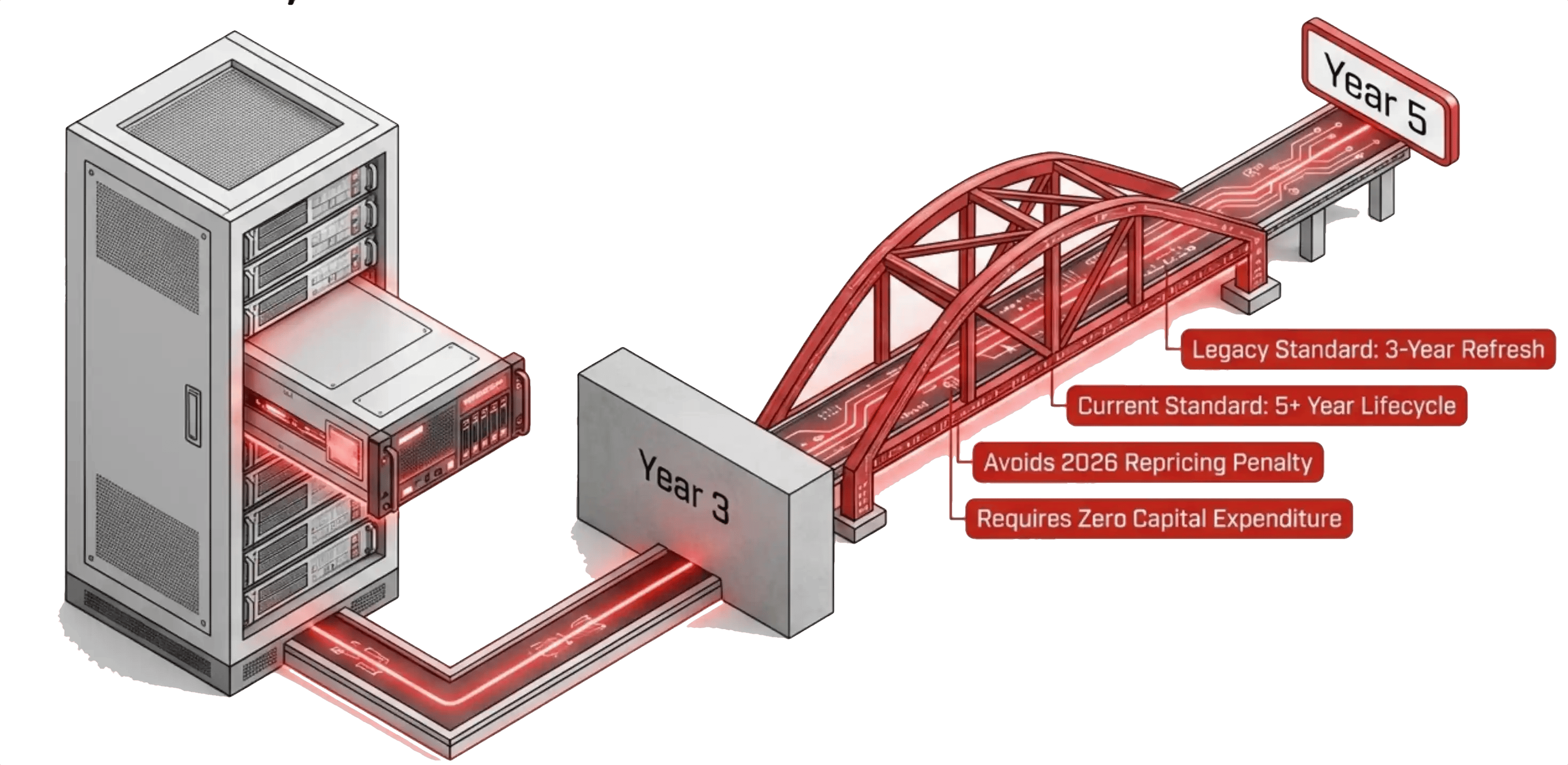
The refresh cycle is where this becomes a decision rather than an observation. Three to five years became the standard rhythm when replacement hardware arrived cheaper and faster than the gear it replaced. Both halves of that assumption broke this year. Keeping a healthy server two more years buys two more years at the old cost basis. The alternative is paying 2026 prices for capacity the organization already has running.
Rising cloud costs make extending that refresh cycle more valuable because the alternative no longer provides the predictable cost escape it once appeared to offer. Capacity already installed in the data center carries a known acquisition cost and no provider allocation decision.
Growth extends the same logic into the secondary market. Quality used enterprise equipment costs real money, and secondary pricing firmed as the primary market tightened behind it. Measured against new hardware that repriced this year, it remains the less expensive way to add a node. It also ships on a schedule owing nothing to a supplier’s allocation queue. Enterprise-grade equipment is the relevant category rather than consumer parts, and a refurbisher’s warranty separates a strategy from a gamble.
The Infrastructure Platform Has to Preserve Hardware Choice
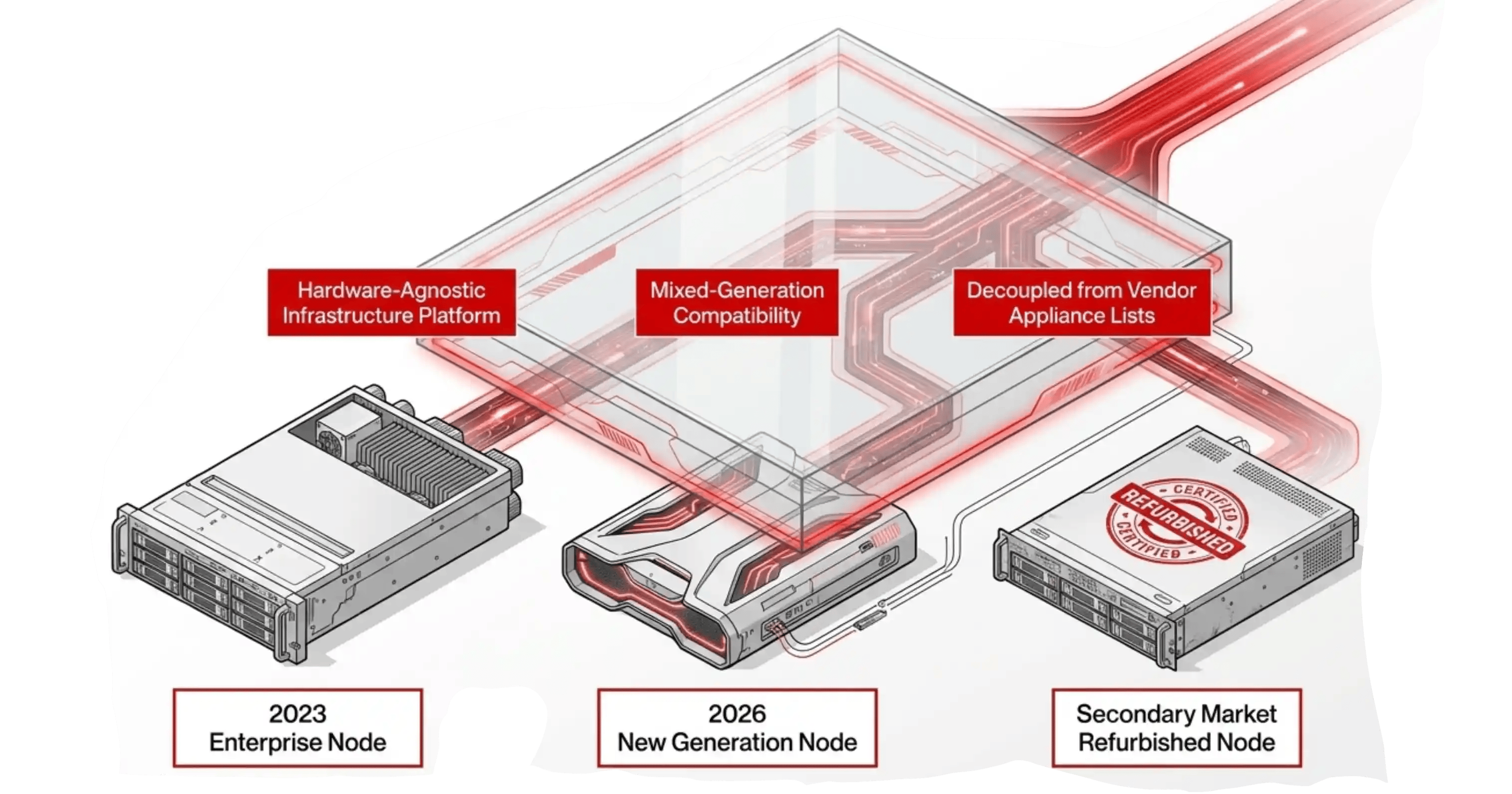
That plan has one dependency, and it sits in software. Running servers longer and scaling with used equipment both require an infrastructure platform indifferent to what runs underneath it. Three properties decide whether an organization holds that option at all.
An environment locked to one vendor’s current-generation parts list holds no ownership strategy at all. The hardware choice belongs to the supplier, the refresh date belongs to the support matrix, and the organization ends up renting equipment it already paid for. Hardware freedom is what converts ownership into an advantage, especially when rising cloud costs make the rented alternative harder to predict.
What to Do About Rising Cloud Costs Before the Next Renewal
Cloud still answers a specific question well. A dataset with unpredictable growth belongs there. So does a project starting in three weeks, or a disaster recovery target that runs cold most of the year. Treat that capacity as a supply line with its own lead time. Then ask the provider for a committed allocation in the regions the business permits, in writing, on a date.
The harder question comes next. Which part of the environment can change hardware without changing platforms? That answer decides how much of this repricing an organization absorbs, and rising cloud costs make it one of the most expensive lines in the evaluation. The teams that came through the first half of 2026 in reasonable shape all answered it the same way. They qualified a substitute part, bought from a different supplier, and kept running.
Renting capacity was a fine instinct. Rising cloud costs revealed the catch: the hatch opened onto the same room, and the floor under it is the hardware already paid for.
VergeIO hosts a session on August 20 at 1:00 PM ET. An industry analyst opens with new research on how 400 enterprises are answering the component repricing. The hour then covers what to demand of a software-defined storage platform. Two live demonstrations close it, on high availability and storage migration across media types.
Register for the storage infrastructure sessionFrequently Asked Questions About Rising Cloud Costs
Does moving workloads to public cloud avoid component repricing?
No. Cloud regions get built from the same DRAM and NAND that repriced this year, so the constraint reaches the provider before it reaches the tenant. Providers allocate scarce parts among competing workloads, which can constrain general enterprise compute as demand for AI infrastructure grows.
Why can rising cloud costs hurt more than owning hardware during inflation?
A rental agreement can reprice when the commitment ends. An owned asset fixes its acquisition cost at the purchase date, so later inflation reaches operating expenses such as power and support rather than changing the original hardware purchase price. Each additional month in production spreads that purchase price across more workload-months.
Is buying refurbished enterprise server hardware a sound strategy?
Quality used enterprise equipment costs real money, and secondary pricing firmed as the primary market tightened. Measured against new hardware that repriced this year, it can remain a less expensive way to add a node. Enterprise-grade equipment with a refurbisher’s warranty is the relevant category. Consumer parts belong nowhere near a data platform.
What should I look for in a platform that lets me run hardware longer?
Look for three properties. The platform should install on standard enterprise servers rather than an approved appliance list, run mixed hardware generations in one environment, and price on terms that remain predictable as the estate grows. A license that meters raw physical capacity can reduce the economic advantage of adding inexpensive storage media.
Do Azure capacity limits apply outside the United Kingdom?
Users reported constraints in North Europe and several US regions as well. The UK case is a useful illustration because the country has only two Azure regions, so a data residency commitment can narrow a much larger global region footprint to a small number of acceptable locations.

George Crump is the Chief Marketing Officer at VergeIO, the leader in Ultraconverged Infrastructure. Prior to VergeIO he was Chief Product Strategist at StorONE. Before assuming roles with innovative technology vendors, George spent almost 14 years as the founder and lead analyst at Storage Switzerland. In his spare time, he continues to write blogs on Storage Switzerland to educate IT professionals on all aspects of data center storage. He is the primary contributor to Storage Switzerland and is a heavily sought-after public speaker. With over 30 years of experience designing storage solutions for data centers across the US, he has seen the birth of such technologies as RAID, NAS, SAN, Virtualization, Cloud, and Enterprise Flash. Before founding Storage Switzerland, he was CTO at one of the nation's largest storage integrators, where he was in charge of technology testing, integration, and product selection.


