
Memory and flash prices are not coming down on the usual cycle. Conventional DRAM contract prices rose 90 to 95 percent quarter-over-quarter in Q1 2026, and TrendForce projects another 58 to 63 percent on top in Q2. The memory market broke in 2025, and the assumption that prices will normalize on the usual cycle is wrong. DRAM and NAND flash are not in a temporary shortage. They are in a structural reallocation that will hold prices elevated through 2027 and likely reset the long-term floor above where buyers remember it. IT leaders building 2026 infrastructure budgets on 2024 component pricing are working from numbers that no longer exist.
Key Takeaways
- This is a structural reallocation of wafer capacity to High Bandwidth Memory (HBM), not a cyclical shortage that self-corrects.
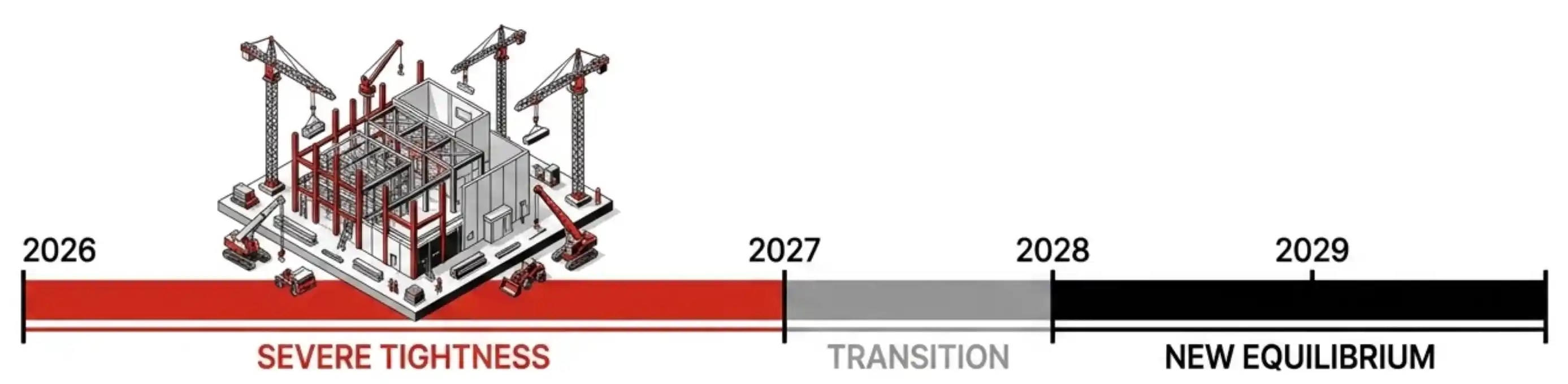
- New fab capacity will not arrive in volume before late 2027, with meaningful relief pushed into 2028 or 2029.
- Storage architects should plan for elevated component pricing as the new baseline, not a temporary spike.
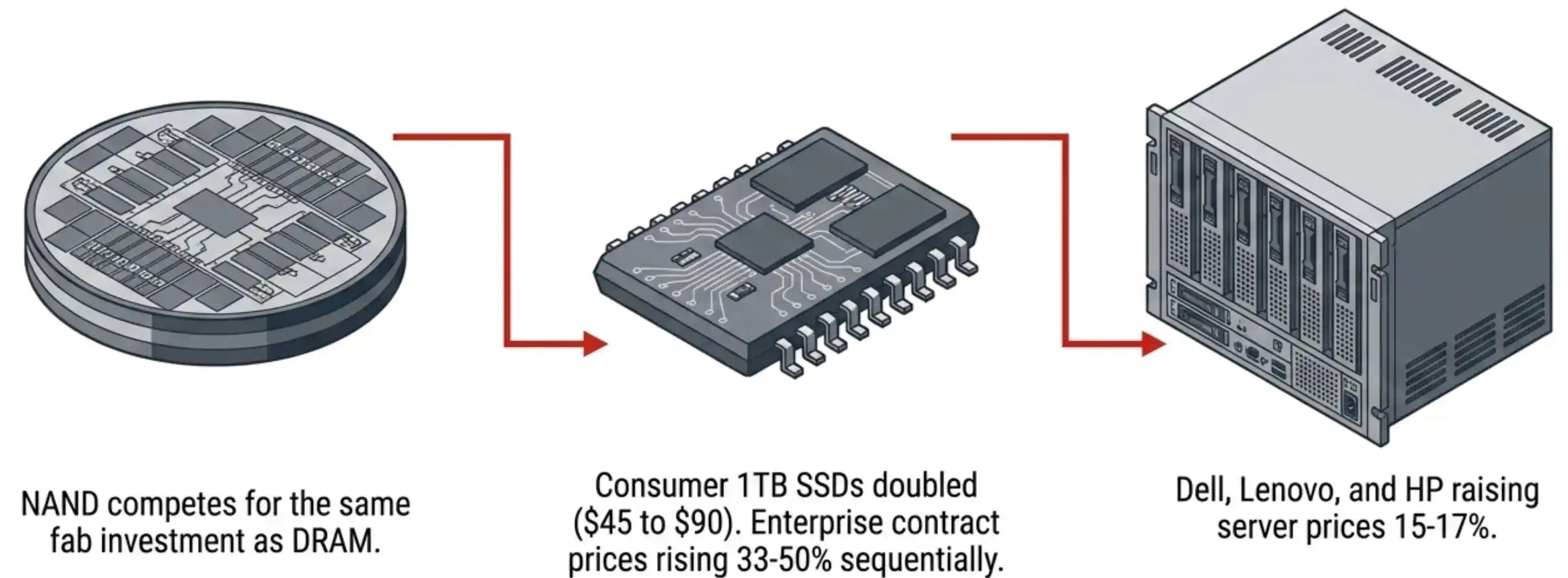
NAND flash contract prices are climbing 70 to 75 percent in the same quarter. Consumer SSD prices have doubled in some cases since late 2025, with 1TB consumer SSDs jumping from approximately $45 to nearly $90. These are not adjustments. They are repricings.
Key Terms
HBM (High Bandwidth Memory)
Stacked DRAM packaged for AI accelerators.
3-to-1 Trade Ratio
Each HBM wafer manufactured displaces approximately three wafers of conventional DRAM output.
Wafer Reallocation
A deliberate manufacturer decision to shift cleanroom output toward higher-margin products. Reverses only when manufacturers choose to reverse it, not when calendar time passes.
Why Memory and Flash Prices Are Different This Cycle
IDC now expects 2026 DRAM supply growth of only 16 percent year-on-year, with NAND supply growth at just 17 percent, both figures sitting well below the 20-30 percent historical norms that defined the post-2018 memory market.
The signal: DRAM lead times have stretched beyond 40 weeks. Memory now accounts for 35 percent of PC build materials, up from roughly 20 percent a year ago. The component cost line has moved from manageable variable to dominant fixed input.
Demand Is Climbing While Supply Is Locked Up
Buyers hoping that demand will soften and pull prices down should look at what the analysts are forecasting. TrendForce projects the total memory market to reach $551.6 billion in 2026 and surge to $842.7 billion in 2027, a 53 percent year-over-year jump. NAND flash market revenue alone is expected to grow 112 percent year-over-year in 2026 to $147.3 billion. Demand is not cooling. It is accelerating.
The driver is generative AI moving from training to inference. AI agents now access vector databases for retrieval-augmented generation, which means high-IOPS enterprise SSDs in volume. Commercial Times reports that NAND demand in 2026 will grow 20 to 22 percent year-over-year while supply rises only 15 to 17 percent. Counterpoint Research projects that DDR5 64GB RDIMM modules used in enterprise data centers could cost twice as much by the end of 2026 as they did in early 2025.
The supply side is already committed. SK Hynix reported during its October 2025 earnings call that its HBM, DRAM, and NAND capacity was sold out through 2026. Micron CEO Sanjay Mehrotra predicted supply tightness continuing into 2027. Phison CEO Khein-Seng Pua confirmed in November 2025 that “every NAND manufacturer told us 2026 sold out. All the capacity sold out.”
Lead times for larger DRAM orders have extended beyond 40 weeks, making many configurations unworkable for fiscal 2026 planning. Enterprise buyers without multi-year contracts compete for residual allocation against hyperscalers that pay more and commit to longer terms. Smaller buyers have lost most of their leverage. As we recently noted, the memory crisis has become Broadcom’s best retention tool, locking infrastructure buyers into renewal cycles they would otherwise have escaped.
The Ripple Effect on Flash Storage and Servers
The memory crunch has rippled directly into flash storage and server pricing. NAND production lines compete for the same fab investment dollars, the same cleanroom capacity, and the same engineering attention as DRAM. When manufacturers shift toward HBM, NAND output suffers in parallel. NovoServe reports enterprise SSD contract prices rose 40 to 50 percent in Q4 2025, and TrendForce predicts another 33 to 38 percent increase in Q1 2026 with all NAND flash categories rising. Enterprise flash pricing is climbing in lockstep with DRAM.
New Fab Capacity Will Not Save 2026 or 2027
The standard counterargument is that capital expansion will solve the problem. The fab construction timeline rules out near-term relief. New fabrication facilities require at least 12 to 18 months to bring online. Billions of dollars in CHIPS Act subsidies and global expansion plans cannot change physics. New fabs from Samsung, SK Hynix, Micron, and Kioxia will not reach meaningful production volume until late 2026 or 2027.
The fabs that would meaningfully expand DRAM and NAND supply are not scheduled to come online until 2027 at the earliest, and even then, priority will remain with HBM and enterprise products. TrendForce reports that Micron is waiting for its new ID1 fab in the United States to become operational, which is not expected before 2027. The new capacity arrives already committed. None of it is intended for the commodity market that storage and server buyers depend on.
The data points to 2027 as the earliest credible window for real relief. Getting back to normal pricing and availability looks more like 2028 to 2029, and that timeline assumes AI infrastructure demand grows at current forecast levels rather than accelerating further. Any AI demand acceleration pushes the relief window out, not in.
What This Means for Storage Architecture
The pre-2025 memory pricing baseline is gone. Buyers planning all-flash refreshes, dense memory configurations, or large SSD-backed caches are facing a permanently more expensive component baseline that will not unwind on any planning horizon that matters for 2026 capital decisions.
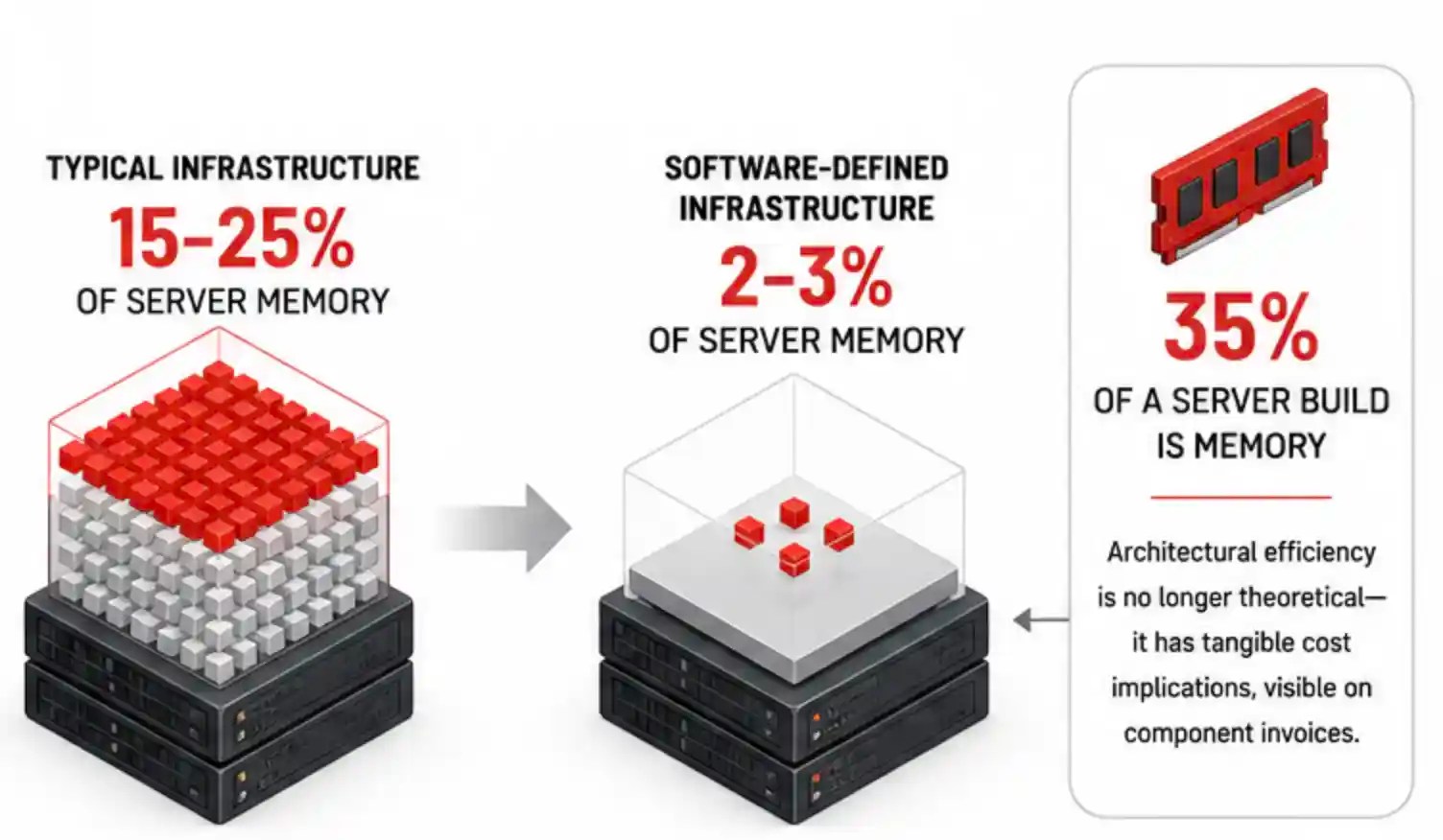
Achieving this requires a new design philosophy that unifies virtualization, storage, networking, and data protection into a single code base, as demonstrated by VergeOS.
Treat the Next 24 Months as a Procurement Event
Storage and infrastructure leaders should not treat this as a wait-it-out cycle. As part of a storage refresh, look for architectures that support off-the-shelf refurbished SSDs from multiple sources, and stick with N+2 data protection to absorb the failure rates that come with mixed media. If your refresh is scheduled within the next twelve months, do it now!
The procurement reality forces an architectural question. Infrastructure that pools storage, compresses aggressively, tolerates mixed media, and absorbs failure rates without service interruption now carries a hard financial advantage over closed architectures that depend on uniform new-flash refreshes. The full case for that architectural shift, including refurbished enterprise SSD procurement and the VergeOS resilience model, is in the VergeIO white paper on solving the storage crisis with refurbished enterprise drives.
Frequently Asked Questions
When will memory prices return to 2024 levels?
They probably will not. Analysts expect gradual relief starting in 2027 with broader normalization in 2028 to 2029, but at a higher equilibrium than pre-2025 baselines.
Why does HBM production affect SSD prices?
Memory manufacturers have shifted wafer capacity and capital toward HBM and high-margin enterprise DRAM. NAND production lines compete for the same fab investment dollars and the same engineering attention, so flash supply tightens alongside DRAM.
Should we delay infrastructure refreshes and wait for prices to drop?
Waiting carries more risk than acting. Lead times exceed 40 weeks for many configurations, and prices are still climbing quarter-over-quarter. Buyers who delay face the dual penalty of higher prices and longer waits.

George Crump is the Chief Marketing Officer at VergeIO, the leader in Ultraconverged Infrastructure. Prior to VergeIO he was Chief Product Strategist at StorONE. Before assuming roles with innovative technology vendors, George spent almost 14 years as the founder and lead analyst at Storage Switzerland. In his spare time, he continues to write blogs on Storage Switzerland to educate IT professionals on all aspects of data center storage. He is the primary contributor to Storage Switzerland and is a heavily sought-after public speaker. With over 30 years of experience designing storage solutions for data centers across the US, he has seen the birth of such technologies as RAID, NAS, SAN, Virtualization, Cloud, and Enterprise Flash. Before founding Storage Switzerland, he was CTO at one of the nation's largest storage integrators, where he was in charge of technology testing, integration, and product selection.


[…] just for RAM. Teams delay upgrades, forcing developers onto older machines with longer build times. Storage Swiss reports no price relief until Q4 2027 at […]