
IT teams planning a VMware exit eventually reach the storage decision, and for most of them it narrows to HCI or AFA. The all-flash array has a long record as the safe home for mission-critical data. Hyperconverged infrastructure earned a reputation for simplicity and picked up doubts about what happens when parts fail. Resiliency, the ability to keep an application running with zero downtime and zero data loss through a component failure, depends far more on architecture than on the media inside the box.
Key Takeaways
- A modern all-flash array and a well-designed HCI cluster handle a single drive failure about equally well.
- The AFA keeps resiliency inside one enclosure and hands server failure and site loss to the hypervisor and a second array.
- Delivering HCI resiliency past the protection limit takes a fully integrated infrastructure software platform, the model VergeOS follows.
The decision costs more in 2026 than it did three years ago. Flash and memory prices climbed sharply this year, and the hardware bill for a migration now dwarfs the hypervisor license that started the project. Every step up in resiliency comes with a price, from a second controller to a separate product that recovers what the first layer missed.
Key Terms
All-flash array (AFA)
A shared storage system built on flash media, typically with dual controllers and RAID 6 or a dual-parity scheme, serving volumes to separate compute hosts.
Resiliency factor (RF2, RF3)
The number of synchronous copies an HCI platform keeps of each block on different servers. RF2 survives one failure and RF3 survives two.
ioGuardian
The VergeOS capability that delivers missing data segments to VMs in real time during multiple drive or server failures, using a dedicated server called the ioGuardian target.
Virtual data center (VDC)
A single VergeOS object that encapsulates VMs, networking, and storage settings, so the whole environment replicates and fails over together.
How All-Flash Arrays Deliver Resiliency
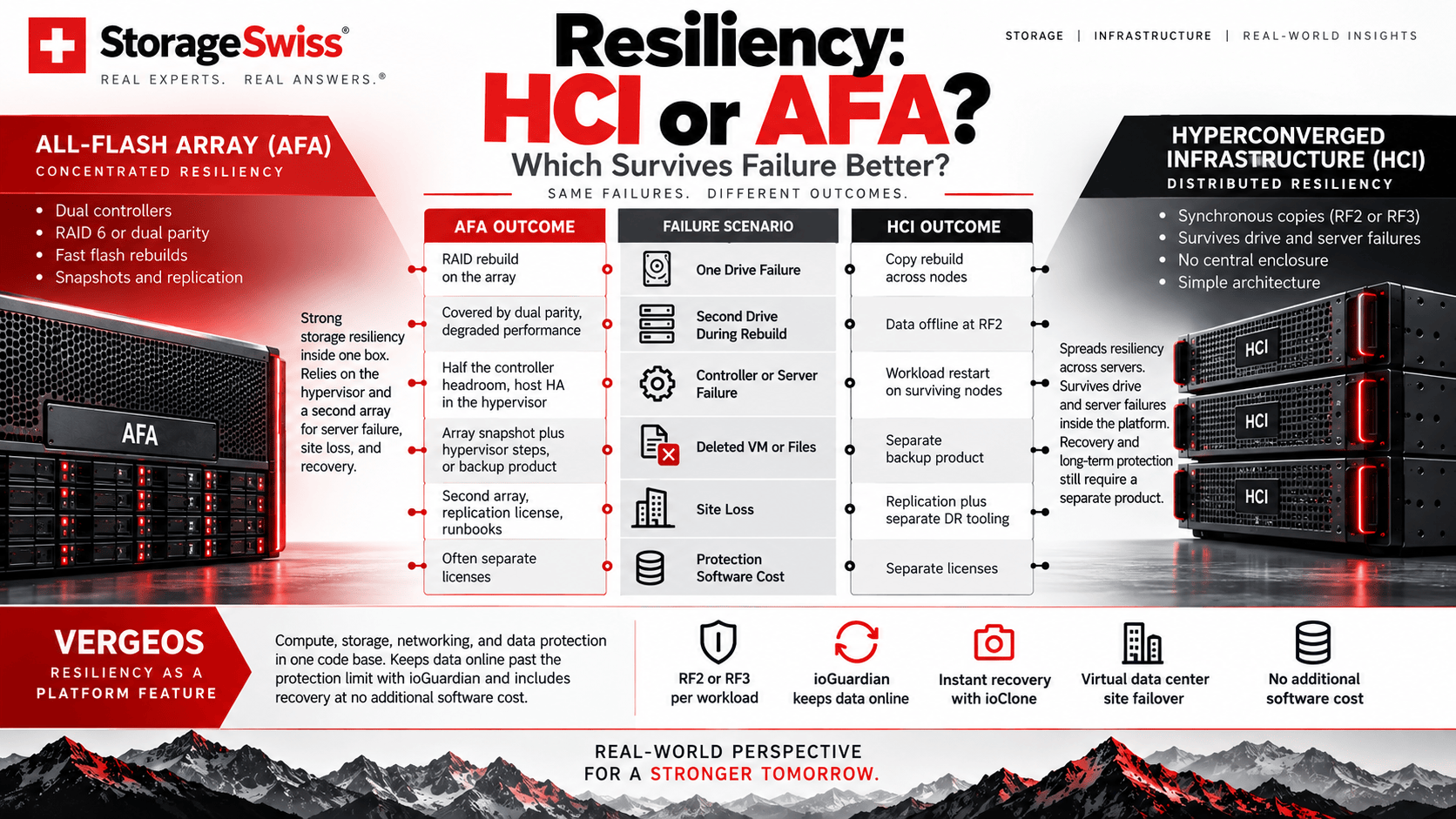
An all-flash array concentrates resiliency inside one enclosure. Dual controllers cover a controller failure, and RAID 6 or a vendor dual-parity scheme covers two drive failures. Flash rebuilds far faster than hard disks, which shrinks the window for a second failure to cause trouble. Mature arrays add non-disruptive firmware upgrades and space-efficient snapshots, and most offer replication to a second array.
The weak points sit at the edges of the box. A controller failure removes half the processing headroom, so an array running both controllers above 50 percent busy runs short the moment it loses one. The array protects volumes and sees nothing of the servers above it. A failed host is the job of the hypervisor HA feature, a separate layer with its own settings. Surviving a site loss takes a second array, usually a replication license, and a runbook that restarts VMs in the right order.
How HCI Delivers Resiliency
HCI spreads resiliency across servers. Each block exists as two or three synchronous copies on different nodes, so the cluster survives a failed drive or an entire failed server. Workloads from a failed node restart on the surviving nodes inside the same platform. The failure domain is the individual server, and the design has no central enclosure or controller pair to lose.
First-generation HCI earned its doubts honestly. An RF2 cluster in the middle of a rebuild has zero margin left, and a second failure in that window takes data offline. Rebuilds compete with production for the same CPUs, so performance dips right when the cluster is under the most stress. Recovery from a deleted VM or a ransomware event still lives in a separate backup product on separate hardware, with its own license and console.
Head to Head
| Failure | All-Flash Array | First-Generation HCI | VergeOS |
|---|---|---|---|
| One drive | RAID rebuild on the array | Copy rebuild across nodes | RF2 or RF3, workload unaffected |
| Second drive during rebuild | Covered by dual parity, degraded performance | Data offline at RF2 | ioGuardian keeps data online |
| Controller or server | Half the controller headroom, host HA in the hypervisor | Workload restart on surviving nodes | Automatic restart on surviving nodes |
| Deleted VM or files | Array snapshot plus hypervisor steps, or backup product | Separate backup product | ioClone snapshot, hot plug drive |
| Site loss | Second array, replication license, runbooks | Replication plus separate DR tooling | Virtual data center failover |
| Protection software cost | Often separate licenses | Separate licenses | Included in VergeOS |
Scored on hardware failure alone, a modern AFA and a well-designed HCI cluster finish close to even. The array holds up better than a two-copy cluster through a second drive failure. HCI handles a server failure inside the platform. The bigger gap opens past the protection limit and at recovery, where both designs hand the problem to another product.
Delivering HCI Resiliency Takes More Than HCI
Closing those gaps takes a different architecture. First-generation HCI layers a storage service on top of a hypervisor, often as a controller VM on every node, and it relies on separate products for backup and replication. Each layer keeps its own metadata and its own view of the workload. The storage layer knows blocks, the hypervisor knows VMs, and the DR tool sees too little of either to repair or restore the whole application by itself.
The next step for HCI is a fully integrated infrastructure software platform. Compute, storage, networking, and data protection share one code base and one set of metadata, so the platform understands each workload as a complete object. Real-time repair during a double failure depends on that shared view. So does a snapshot or DR failover that restores the VM together with its storage and network settings. VergeIO builds VergeOS on this model.
What an Integrated Platform Delivers
Inside VergeOS, resiliency settings and recovery tools live in the same platform. Administrators set RF2 or RF3 per workload. When a server fails, VergeOS restarts its workloads on surviving nodes automatically.
VergeOS closes the two gaps that kept HCI behind the array for many buyers. The first is the double-failure window, which ioGuardian covers. The ioGuardian target delivers missing data segments to VMs in real time, and workloads keep running through failures beyond the resiliency factor as the system repairs itself. The second is recovery. ioClone snapshots behave as independent copies, so a deleted VM returns instantly and individual files come back through a hot plug drive attached to the running VM.
Site recovery follows the same model, with a virtual data center failing over to the DR site as one object. The capacity math shifts too. Global inline deduplication across every drive and server narrows the gap between RF2 and parity RAID, and RF2 improves read performance by serving data from multiple copies. Existing servers and refurbished drives make RF3 affordable, which puts resiliency spending into capacity rather than another controller pair.
So, HCI or AFA?
For a VMware exit, HCI is the stronger answer, provided the platform keeps data online past its protection level and recovers from the same interface. An all-flash array is a sound storage device. It still depends on the hypervisor for server failures and on a second array plus a backup product for site loss and recovery. First-generation HCI moved storage into the servers and left recovery outside. An integrated infrastructure software platform such as VergeOS brings recovery inside at no additional software cost, and the Resilient Private Cloud OS datasheet covers the details.
Watch Every Failure Live
The Premier Connects session, Exit VMware to Resilient HCI: Integrated Data Protection, Faster Recovery, and Built-In DR, puts each of these failures on screen. Aaron Richman, Field Evangelist at VergeIO, walks through each feature, and Dave Vincent, Technical Solutions Strategist, demonstrates it live on a running VergeOS environment. The demos start with a pulled drive and a failed server, move to two failed drives and a deleted VM, and finish with a full virtual data center failover.
Frequently Asked Questions
Is an all-flash array more resilient than HCI?
For drive failures inside one system, a dual-parity AFA and an RF3 HCI cluster protect data at a similar level. HCI also survives a full server failure inside the platform. The AFA depends on the hypervisor for server failures and on a second array for site failures.
What happens when two drives fail in an RF2 HCI cluster?
In most first-generation HCI designs, data on those drives goes offline and recovery shifts to a backup product. VergeOS uses ioGuardian to deliver the missing data segments to VMs in real time, so workloads keep running as the system repairs itself.
Do I still need a backup product with VergeOS?
VergeOS includes snapshots, instant VM recovery, and virtual data center failover. Many customers keep the backup platform they already run, including Veeam, for long-term retention and archiving, and VergeOS supports it.

George Crump is the Chief Marketing Officer at VergeIO, the leader in Ultraconverged Infrastructure. Prior to VergeIO he was Chief Product Strategist at StorONE. Before assuming roles with innovative technology vendors, George spent almost 14 years as the founder and lead analyst at Storage Switzerland. In his spare time, he continues to write blogs on Storage Switzerland to educate IT professionals on all aspects of data center storage. He is the primary contributor to Storage Switzerland and is a heavily sought-after public speaker. With over 30 years of experience designing storage solutions for data centers across the US, he has seen the birth of such technologies as RAID, NAS, SAN, Virtualization, Cloud, and Enterprise Flash. Before founding Storage Switzerland, he was CTO at one of the nation's largest storage integrators, where he was in charge of technology testing, integration, and product selection.


Leave a comment