
Veeam Application-Consistent Backup Without the Guesswork
By George Crump, Storage Switzerland
A VMware exit plan lives or dies on a handful of hard questions, and one of the sharpest belongs to the backup team. Can the new platform deliver a clean, application-consistent backup of the workloads that run the business, the SQL Server instance behind the ERP system, the mail store, the domain controller? A backup that captures a disk image is not the same thing as a backup that captures a database in a state SQL Server can open without repair, and the gap between those two outcomes decides what a restore delivers on the worst day of the job.
Key Takeaways
- Veeam Backup & Replication distinguishes crash-consistent backup, the platform-level default, from application-consistent backup, which needs in-guest preparation, and the difference decides whether a restored SQL Server database opens clean.
- On VergeOS, application-consistent backup requires the Veeam Deployment Toolkit installed in the guest. Veeam installs its own backup agent automatically during the first backup job.
- The mechanism reaches past SQL Server to the other applications Veeam processes, and it covers Linux guests and Windows guests alike.
- Veeam Explorers can extract application items from a crash-consistent backup at restore time, but only a prepared backup guarantees the extracted data is transaction-consistent.
- VergeOS gets the same Deployment Toolkit mechanism Veeam already uses for vSphere and Hyper-V, the same treatment given an established platform.
The Two Kinds of "It's Backed Up"
A crash-consistent backup captures storage in the state it happens to be in at the moment of capture, the equivalent of pulling the power cord and hoping the file system recovers cleanly. Modern journaling file systems and databases with write-ahead logs usually recover from that state, and Change Block Tracking backups across virtualization platforms default to it. An application-consistent backup goes further. Veeam quiesces the application first, flushes pending transactions to disk, and confirms the database or mail store closes its transaction logs before the backup runs. The restored copy opens the way the application left it, not the way a snapshot happened to catch it.

Same VM, same backup job. The difference is what happens before the disk is captured.
Key Terms
Crash-consistent backup
A backup that captures storage in whatever state it happens to be in at the moment of capture, without coordinating with the application running inside the VM.
Application-consistent backup
A backup where the application flushes pending transactions and closes its logs before the backup runs, so the restored copy opens clean.
Veeam Deployment Toolkit
The Veeam component installed inside a VergeOS guest that lets Veeam install and run its own backup agent automatically, starting with the first backup job.
Veeam Explorers
Veeam’s tools for opening a backup and restoring individual application items, such as a mailbox, a database table, or an Active Directory object, without restoring the whole VM.
Universal Hypervisor API
The Veeam framework that brings a new virtualization platform into Veeam Backup & Replication as a supported platform, rather than through a driver written for a different platform.
What the Veeam Deployment Toolkit Does on VergeOS
VergeOS became a supported platform in Veeam Backup & Replication 13.1 through the Universal Hypervisor API, and it makes a useful worked example here. Dave Vincent, VergeIO’s Technical Solutions Strategist, tested this directly in the lab rather than reading it off a data sheet. A VergeOS Windows VM needs the Veeam Deployment Toolkit installed before the first backup. From there, Veeam takes over. During that first backup job, Veeam installs its own backup agent inside the guest automatically, no separate deployment step and no script for the administrator to run by hand. For a VM running SQL Server, that agent quiesces the database and flushes its logs before Veeam closes the backup. The same mechanism reaches beyond SQL Server to the other applications Veeam processes, and it covers Linux guests and Windows guests alike. Skip the Deployment Toolkit and the platform-level backup still runs, staying crash-consistent instead of application-consistent.
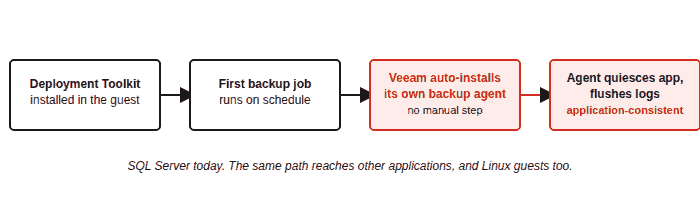
SQL Server today. The same path reaches other applications, and Linux guests too.
Restore Time Tells a Different Part of the Story
Application consistency at backup time answers only part of the question. Veeam Explorers, the tool Veeam uses to open a backup and pull a single mailbox, table, or Active Directory object, detects applications at restore time, not at backup time. Point Veeam Explorer for SQL Server at a crash-consistent backup, and it still finds the database and extracts objects from it. What changes is whether the extracted objects come from a transaction-consistent state or a state the database engine has to repair on its own before Veeam can read it cleanly. The Deployment Toolkit buys certainty at restore time. Without it, the outcome depends on the database engine’s crash recovery, which usually works but occasionally doesn’t.
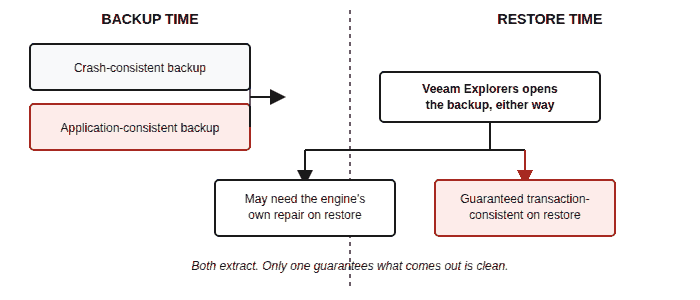
Both extract. Only one guarantees what comes out is clean.
The Same Toolkit Veeam Uses Everywhere Else
Vendors integrating a new platform into an established backup product are tempted to ship a thin connector that backs up virtual disks and stops there. Veeam brought the Deployment Toolkit and its automatic agent installation to VergeOS as the same mechanism it already uses for vSphere and Hyper-V. A platform arriving through the Universal Hypervisor API inherits the full application-awareness stack Veeam built for the platforms it has protected for years. That is a real engineering choice, not the minimum needed to add a platform to a compatibility list.
The Question to Ask About Application-Consistent Backup
A backup administrator qualifying any new platform in Veeam Backup & Replication should ask one direct question. Does application-consistent backup here require the same in-guest preparation Veeam asks for everywhere else, or does it depend on a workaround built for this platform alone? On VergeOS, the answer is the Deployment Toolkit, installed once, doing the same job it does on every other platform in the product. An unqualified yes to application-consistent backup fails that test as fast as an unqualified no. Name the condition, and the claim holds up.
Veeam Backup & Replication can also handle multi-hypervisor consolidation onto VergeOS, using the same Entire VM Restore engine to bring workloads in from other platforms, not just protect the ones already running there. Consolidate every platform onto VergeOS with Veeam covers that migration path in full.
VergeIO and Veeam demonstrate the integration live on Thursday, September 3, 2026 at 2:00 PM ET / 11:00 AM PT, including a backup and restore Dave Vincent runs on stage. Registration is open at verge.io/vergeos-veeam-integration/webinar-registration. The full capability set is documented at Leave VMware. Keep Veeam.
Frequently Asked Questions
Does Veeam back up VergeOS VMs without any extra configuration?
Yes. Backup jobs run at the platform level as soon as Veeam points to a VergeOS Manager, and Change Block Tracking backups start immediately. That baseline backup is crash-consistent.
What has to happen for a VergeOS backup to become application-consistent?
A Windows or Linux guest needs the Veeam Deployment Toolkit installed before the first backup. Veeam installs its own backup agent inside the guest automatically during that job and uses it going forward.
Does the Deployment Toolkit only help with SQL Server?
The mechanism reaches past SQL Server to the other applications Veeam processes, and it covers Linux guests and Windows guests alike.
If the Deployment Toolkit is skipped, is the backup still usable?
Yes. The platform-level backup still runs and stays crash-consistent, a valid backup that is not guaranteed to open a database cleanly on restore.

George Crump is the Chief Marketing Officer at VergeIO, the leader in Ultraconverged Infrastructure. Prior to VergeIO he was Chief Product Strategist at StorONE. Before assuming roles with innovative technology vendors, George spent almost 14 years as the founder and lead analyst at Storage Switzerland. In his spare time, he continues to write blogs on Storage Switzerland to educate IT professionals on all aspects of data center storage. He is the primary contributor to Storage Switzerland and is a heavily sought-after public speaker. With over 30 years of experience designing storage solutions for data centers across the US, he has seen the birth of such technologies as RAID, NAS, SAN, Virtualization, Cloud, and Enterprise Flash. Before founding Storage Switzerland, he was CTO at one of the nation's largest storage integrators, where he was in charge of technology testing, integration, and product selection.


