One of the significant challenges regarding data protection is managing its data set. Secondary storage tiers store five to ten times as much data as production data stores and can overwhelm the data center. IT planners are looking to cloud…
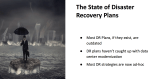
Disaster Recovery Plans (DRP) are supposed to be an organization’s playbook if they need to recover critical data center operations after a disaster. The issue is that in most organizations, the DRP is outdated if it exists at all. Disaster…
Data Management (archiving) looks good on the IT whiteboard. It is the process of moving old data from existing primary storage systems to an archive system. The process should free up primary storage capacity, simplify the data protection process and…
Many studies indicate that organizations have a shallow confidence level in their ability to recover from a disaster. The disaster recovery plan is often an ad-hoc plan that requires IT to scramble when disaster strikes. If the recovery effort succeeds,…
Analytics is evolving from big data, machine learning to artificial intelligence. Machine learning is the analysis of data at rest, artificial intelligence (AI) is the analysis of data in real-time. Machine learning is predictive; AI is cognitive. The requirements of…
The Security Problems with Multi-Vendor Data Storage One of the most common data center trends is storage system sprawl. In today’s data center, every environment or workload has a unique storage architecture. While dispersed storage does allow IT to target…
Accuracy and response time defines the success or failure of an AI or analytics project. The faster and more accurate the response the more trusted the system is. The more data provided to the project the more accurate it becomes.…