
Users and application owners expect that the systems they use will never go down, and if they do they will be returned to operation quickly with little data loss. In our article “Designing Primary Storage to Ease the Backup Burden”…
Users and application owners expect that the systems they use will never go down, and if they do they will be returned to operation quickly with little data loss. In our article “Designing Primary Storage to Ease the Backup Burden”…

Thanks to recent advancements in software and hardware, data centers have a unique opportunity to make their storage infrastructures more responsive, more cost-effective and easier to manage. For the past few years, primary storage has had this opportunity because of…

In this video, we get an example of the in the trenches, real world training provided at the Storage Decisions / TechTarget Backup 2.0 Workshop featuring Storage Switzerland’s Founder and Lead Analyst, George Crump. Watch this interactive, vendor agnostic, deep…
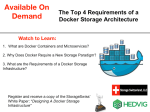
In a recent StorageSwiss survey, 40% of respondents indicated that they were interested in deploying Docker into production, as a compliment or potentially as an alternative to VMware. Docker containers are resource efficient and extremely flexible, which have lead to its…
We are in the home stretch of the 2015 Backup 2.0 Technical Workshop, a comprehensive day of data protection education. At the workshop, we provide you with specific designs to meet demands for faster recovery and longer retention. Our sessions…

As the world of applications explode, an increasing amount of critical business information is being passed between data center sites using IP storage. Most IP storage systems have excellent replication software built into them, but the infrastructure that IP storage…
Workload Mobility is a hot subject at VMworld 2015. The ability to move a virtual machine from a VMware environment to Hyper-V, Amazon AWS or a Cloud Service Provider enables businesses of all sizes to cut the cost and complexity…
High-Performance Compute (HPC) and the storage infrastructure that supports it has long been considered a realm unto itself. Enterprise IT would have nothing to do with it. However, in the past decade, massive I/O bottlenecks have emerged throughout IT infrastructure…

Flash Memory Summit Briefing Note: Radian Eliminates Flash Translation Layer for Improved Performance, Endurance, and Cost The first generation of flash storage devices addressed backward compatibility by treating the devices as if they were hard drives through the use of…

One of the promises of software-defined storage (SDS) is the unification of storage services and the management of those services. The result should be a reduction in the cost to provision and manage storage resources. But some SDS solutions can…


 StorageSwiss.com - The Home of Storage Switzerland