
IT Cloak and Dagger
With the advent of cloud computing, all it takes is the swipe of a credit card to instantly get more storage capacity. Likewise, some users may just opt to purchase their own physical storage and keep it under a desk (and keep IT in the dark about its existence). This “Shadow IT” can be especially prevalent in smaller companies where employees are accustomed to finding their own solutions for the things they need. But that doesn’t make the practice any less of a problem as it reduces productivity and increases the risk of data loss.
Simplicity and Economy
To stave off the Shadow IT threat, managers in SMB environments need to look for solutions that can fulfill a wide variety of their end-users’ needs, before those users find their own solutions. But they also need those solutions to fall within SMB budgets, be easy to work with and easily integrated into the existing environment.
Converged Microsoft NAS
Many small businesses have come to rely on Windows-compatible file servers or network-attached storage (NAS) solutions to provide capacity and protect users’ computer data. In fact, many SMBs are 100% Windows environments so integration with Microsoft applications is often a key decision factor. Ideally, an appliance that could function as both a full-fledged application server and business-class storage array would be that much easier to cost justify.
If this appliance could support up to 25 clients and all of their devices it could meet the storage requirements of the company and its employees, putting an end to individuals “rolling-their-own” storage solutions. Furthermore, if this solution was specifically designed to run Quick Books or any Microsoft compatible application, it could pull triple duty as an on-site application server, a network storage system and a desktop/laptop backup solution.
Cloud DR Redundancy
But businesses also need to ensure the protection of their information and uptime is important, so, ideally, this appliance would be designed with redundant critical subsystems within the box. Data protection features such as point-in-time snapshots should be standard so that IT could quickly restore data directly from the appliance should an end-user accidentally delete a file. And from a DR perspective, the system would provide direct integration with cloud solutions like Microsoft’s Azure so that business data could be replicated offsite for an added level of protection.
Enterprise Class for the SMB
As Storage Switzerland discussed in a recent webinar, technologies like those from Western Digital are making it possible for today’s SMB to enjoy many of the file sharing and data protection benefits that were formerly reserved for large company data centers. WD’s Sentinel S Series Appliance fits into the SMB budget while providing the ability to scale up to 16 TBs of capacity. In addition, the appliance can come with a dual or quad Xeon processor to provide the horsepower needed for file handling and backup and still have enough left over to run software applications on-site.
This combination of features, performance and economics enables the WD Sentinel S Series Appliance to satisfy an SMB’s internal users and make the Shadow IT threat a thing of the past. To learn more about how the Western Digital solution can help simplify your businesses IT needs, please watch this Storage Switzerland webinar with WD’s Paul Chen, “Three Reasons why an SMB’s First Server should be more than a NAS”.
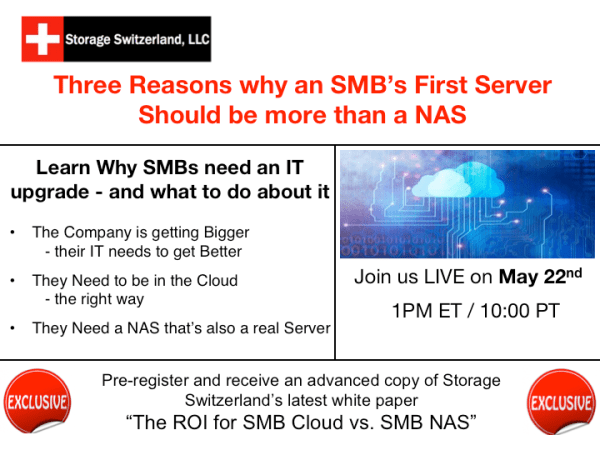
Click To Watch On Demand
Western Digital is a client of Storage Switzerland

As a 22 year IT veteran, Colm has worked in a variety of capacities ranging from technical support of critical OLTP environments to consultative sales and marketing for system integrators and manufacturers. His focus in the enterprise storage, backup and disaster recovery solutions space extends from mainframe and distributed computing environments across a wide range of industries.


 StorageSwiss.com - The Home of Storage Switzerland