
Using consumer-grade flash drives in datacenter environments is a 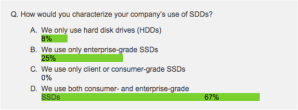 common practice for saving money. So it wasn’t a big surprise that two-thirds of attendees on a recent StorageSwiss webinar reported that they currently use both enterprise and consumer SSDs in their datacenters. But how do you decide when it’s OK to use lower-cost flash drives and when you really need enterprise-grade drives? Where do you draw that line?
This is a subjective question and one that may have a different answer for every datacenter. But maybe it’s the wrong question. Instead of trying to figure out which application servers are right for a lower-cost SSD, maybe the question should be which is the right drive to replace that enterprise SSD. What if you had a drive that was in between, one that offered better performance and reliability than consumer drives but was priced below enterprise drives? What would that SSD look like?
Workloads
For critical applications and write-heavy workloads, like databases and high-transaction environments, enterprise-grade flash drive that are designed for both read and write activity are the best choice.
NAND flash devices have a finite lifespan, as determined by the number of write and erase cycle they conduct, so use cases that includes a lot of write activity can wear a consumer-grade drive out prematurely – and degrade performance in the process.
But many applications that need flash performance are doing a very different kind of job. Web servers, content delivery applications or video streaming, as examples, incur a lot of read activity, and very few writes. In fact, many performance-hungry applications in the datacenter, that aren’t supporting a lot of transactions, are handling more reads than writes. So, improved performance and drive endurance in read-heavy workloads would be an ideal characteristic for an alternative to enterprise-grade SSDs.
Reliability and Replacement
When a flash drive loses power, data not written to flash can be lost. If this is critical metadata the drive may fail to come back up when the power is restored. Enterprise drives typically have circuitry to maintain a charge on the device until data is safely written to flash, but consumer drives do not. This is a common cause of drive failures, which can cause server downtime, and a big reason enterprise SSDs are chosen for many use cases. But a drive with a mechanism to ensure that it would operate after a power failure, even if some write transactions were lost, would be a valuable feature in a lower-cost SSD.
Decreased costs without increased risk
Everyone in IT knows about redundancy, backup, reducing single points of failure – about making the safe choice. Nobody ever got fired for buying the big three-letter nameplate, but the way to get promoted is to reduce data center costs without increasing risk. Replacing enterprise-grade flash drives in some application servers can do that. Choosing the right application servers is important but choosing the right drive may be even more important.
For more information on the risks of using consumer-grade flash drives in your datacenter and the right SSDs to use, take a look at this on-demand webinar from Storage Switzerland “Hyper-scale Nightmare: The Potential Consequences of using Consumer-grade Flash in the Datacenter”.
Watch On Demand
Click Here To Sign Up For Our Newsletter

Eric is an Analyst with Storage Switzerland and has over 25 years experience in high-technology industries. He’s held technical, management and marketing positions in the computer storage, instrumentation, digital imaging and test equipment fields. He has spent the past 15 years in the data storage field, with storage hardware manufacturers and as a national storage integrator, designing and implementing open systems storage solutions for companies in the Western United States. Eric earned degrees in electrical/computer engineering from the University of Colorado and marketing from California State University, Humboldt. He and his wife live in Colorado and have twins in college.


 StorageSwiss.com - The Home of Storage Switzerland