
It has often been said that if you could afford an all-flash data center you would definitely want one. Going all-flash is not just attractive because of the gains in performance that applications will see but also because of how simple storage management and even application development becomes as a result.
The problem of course is that the all-flash data center, even with the gains in data efficiency and the general decreasing cost of flash, is outside of the reach of most IT budgets. And in reality most of the data in the enterprise does not need to be on flash, it is either not being accessed or it simply does not need the performance that all-flash can deliver. Put simply hard drives or some other form of storage will exist for a long time in the typical data center. The big question then is what should this other form of storage be? In this video we propose the use of cloud storage as the solution for the all-flash challenge.
As we discuss in the above video, caching appliances and other forms of data automation can move data from flash to hard disk and back. While one can argue the given pros and cons of the various caching solutions, one has to agree that these solutions push the concept of an all-flash data center even further from reach because they still rely on hard disk based technology residing in the data center to compliment the flash storage.
Again, as we show in the video, technology exists today which allows the storage area that compliments flash to reside in the cloud. This means the data center could cost effectively be all-flash and its more sedentary data could reside in the cloud. The result should be a massive reduction in data center footprint while providing the performance and simplicity of an all-flash data center.
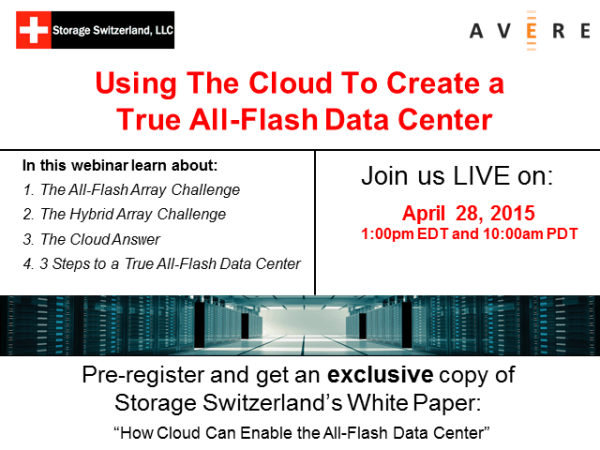
Click To Register
Sponsored by Avere Systems
Click Here To Sign Up For Our Newsletter

George Crump is the Chief Marketing Officer at VergeIO, the leader in Ultraconverged Infrastructure. Prior to VergeIO he was Chief Product Strategist at StorONE. Before assuming roles with innovative technology vendors, George spent almost 14 years as the founder and lead analyst at Storage Switzerland. In his spare time, he continues to write blogs on Storage Switzerland to educate IT professionals on all aspects of data center storage. He is the primary contributor to Storage Switzerland and is a heavily sought-after public speaker. With over 30 years of experience designing storage solutions for data centers across the US, he has seen the birth of such technologies as RAID, NAS, SAN, Virtualization, Cloud, and Enterprise Flash. Before founding Storage Switzerland, he was CTO at one of the nation's largest storage integrators, where he was in charge of technology testing, integration, and product selection.


 StorageSwiss.com - The Home of Storage Switzerland