
All-flash solutions are fast, but not all flash solutions will solve your performance problems. In the enterprise, in the public and private clouds, speed alone isn’t enough. All-flash arrays should also be able to guarantee predictable service levels for each tenant, those internal or external users who expect performance to be both constant and consistent.
For enterprises and cloud providers that run these ‘next generation data centers’ storage capacity and performance are resources to generate, maintain and allocate, similar to the way a utility manages power. To do this effectively their storage infrastructures should be like homogeneous pools for which they manage capacity and performance independently. They also need to rely on automation to balance workloads and help to maintain reliability and operational efficiency.
What is a SolidFire System?
SolidFire builds all-flash storage arrays for these types of environments. And while these systems are certainly fast, SolidFire arrays provide more than just speed. They’re designed from the ground up for agility, scalability, automation, and predictable performance, characteristics that are driving the nextgeneration data centers.
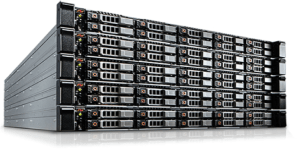
Each 1U storage node contains ten 2.5” SSDs providing up to 9.6TB of effective capacity (including data reduction). Each node has dual 6- or 8-core processors, dual 10GbE iSCSI connectivity and up to 256GB of system memory to support read caching. Configured in clusters of up to 100 nodes, a SolidFire system can provide 3.4PB of capacity and up to 7.5 Million 4k random IOPS in 2-1/2 racks of data center space.
Next Generation Storage Density
Compared with a traditional disk SAN infrastructure, SolidFire’s scale-out storage systems can provide over 8x the capacity and 60x the performance per rack unit. On the cost side, SolidFire systems consume ¼ of the power and cooling and 1/10th of the rack space and cabling of a comparable disk array system.
Control of SolidFire clusters is achieved through the use of REST-based APIs, even the user interfaces. This means that every aspect of system control can be automated, an important feature for enterprise and cloud data centers where operational efficiency is key. This API functionality has also facilitated its integration into management frameworks such as VMware, OpenStack, CloudStack, and others. SolidFire systems support the standard SNMP protocol as well.
Now, SolidFire has announced Element OS 6, a new operating system for this next generation storage infrastructure that enhances its core design philosophy of guaranteed performance, flexibility and operational efficiency at scale. Some of the new features it offers are:
Real-time Replication
Getting data off-site is a fundamental requirement for the next generation data center, often to multiple locations in distributed geographies. Element OS 6 has native replication that enables off-site copies between two sites or geo-clusters between up to four other sites. There are no third-party products to buy and implement and no licenses or support costs.
SolidFire’s replication supports inline deduplication, compression and thin provisioning between copies on different systems to maintain its capacity efficiency. With a non-directional design it supports multiple replication topologies and provides simple failover and failback. The system can also recover from network outage and resume replication without intervention, helping to maintain the automation that’s key to data center operation.
Mixed Node Clusters
Scale-out storage looks like an ideal architecture on the whiteboard, but when the cluster needs to be expanded or upgraded it can present problems. This is because many vendors require that only similar nodes be included in a cluster, making it difficult to add new generations of hardware or software and take advantage of capacity or performance upgrades.
SolidFire’s architecture enables it to manage capacity and performance as two separate resource pools, functionality that helps the system support mixed nodes within the same cluster. This allows users of an existing system to take advantage of the latest capacity, performance and protocols, without impacting legacy storage nodes.
The result is a ‘future proofing’ of the storage infrastructure and the elimination of ‘forklift upgrades’ when adding the newest storage nodes. It also does away with the need to migrate data to a new storage system, allowing it to be upgraded in place. This really allows clusters to grow as homogeneous pool of capacity and performance, in keeping with the utility model mentioned earlier.
Integrated BU and Restore
The next generation data center will approach data protection differently than the traditional process of creating separate backup copies and storing them on a dedicated infrastructure. Instead, data protection will use the primary storage system and leverage the power of snapshots to maintain efficiency and keep costs down.
SolidFire’s Element OS 6 has native backup and restore functionality that creates a snapshot-based copy directly to object storage. Compatible with any REST-based object storage or system that supports the Amazon S3 or Swift APIs, this feature eliminates the need for dedicated backup applications. And since backup is intrinsic within the storage system, it scales without the concerns one would have with a traditional, dedicated backup infrastructure.
Snapshot-based backups maintain data efficiencies by leveraging the data reduction processes resident in SolidFire arrays. Data protection that’s handled on the storage system also pulls the backup tasks off of the host computers, reducing their overhead and improving performance. An array-based process like this also allows infrequently accessed data to be off-loaded to a lower cost object storage tier, further supporting data center efficiency.
FC Connectivity with iSCSI
SolidFire’s Element OS 6 supports 8/16Gb Fibre Channel (FC) clients with a 1U controller module in an active/active HA configuration. Each FC controller has 4 x 16Gb ports to the FC fabric, 4 x 10GbE SFP+ ports for inter-cluster connectivity and two 1GbE management ports. The system provides concurrent iSCSI and FC connectivity on a single cluster to any data volume and supports the full SolidFire feature set.
This feature will enable the SolidFire system to easily go into an FC environment and provide its core benefits of flexible scalability, predictable performance, and automation. When the time is right to migrate to Ethernet, the systems can support migration of data from legacy FC systems over to SolidFire.
Storage Swiss Take
Early on SolidFire identified a need in the cloud and service-provider markets. These companies were providing compute and storage services similar to the way a public utility provides power. They were guaranteeing the service levels their customers demanded and needed a storage infrastructure that was designed to provide them the same thing.
Since their inception, SolidFire has been building scale-out, all-flash clusters for this cloud provider use case, as well as the enterprise where private clouds and large internal infrastructures must meet the same standards. Now, with OS 6, SolidFire is adding to the list of advantages its solutions can provide over traditional storage systems, and other all-flash arrays.
It can now better support geographically-distributed clusters and those with legacy FC networks. A new integrated backup and recovery capability helps provide cost containment and their ability to support mixed nodes in SolidFire clusters provides investment protection and simplifies upgrades.
SolidFire is a client of Storage Switzerland
Click Here To Sign Up For Our Newsletter

Eric is an Analyst with Storage Switzerland and has over 25 years experience in high-technology industries. He’s held technical, management and marketing positions in the computer storage, instrumentation, digital imaging and test equipment fields. He has spent the past 15 years in the data storage field, with storage hardware manufacturers and as a national storage integrator, designing and implementing open systems storage solutions for companies in the Western United States. Eric earned degrees in electrical/computer engineering from the University of Colorado and marketing from California State University, Humboldt. He and his wife live in Colorado and have twins in college.


 StorageSwiss.com - The Home of Storage Switzerland