
Software Defined Storage promises adventurous IT professionals increased flexibility and potentially easier management of storage resources. And in many cases SDS delivers on that promise.
But what about the legacy storage hardware and software already in the data center? Do organizations just push it out the door? The answer is a resounding no. Organizations continue to look for ways to leverage existing assets while at the same time adopting SDS to be more responsive to the needs of the business.
The Value of Legacy Storage
Legacy storage systems still have some advantages. First, organizations know and are confident in the software they own. Second, the hardware tends to be highly reliable. Third, the nature of a dedicated storage system with dedicated storage processors typically means more predictable performance than SDS running within a hypervisor or even on a dedicated commodity appliance.
The SDS Challenge
The challenges facing SDS solutions is, since SDS is software, it wants to replace the existing storage software instead of enhance it. Replacing one snapshot feature for another snapshot feature offers little other than providing commonality across storage systems.
SDS Has to Enhance SAN
Instead of replacing the storage system and its software, SDS solutions should do more than just replace the existing storage feature set. It should enhance it so that the storage infrastructure leverages the existing storage assets and network, while paving a path to the future that integrates commodity storage systems and even the cloud. Ideally data will flow between these systems based on policy instead of requiring detailed decision making.
StorageSwiss’ Take
SDS is the right way forward for storage infrastructures. However, it has to provide a path to leverage current architectures instead of replacing them. To learn more watch our on demand webinar “How To Use Software Defined Storage to Extend Your SAN, Not Replace It“.
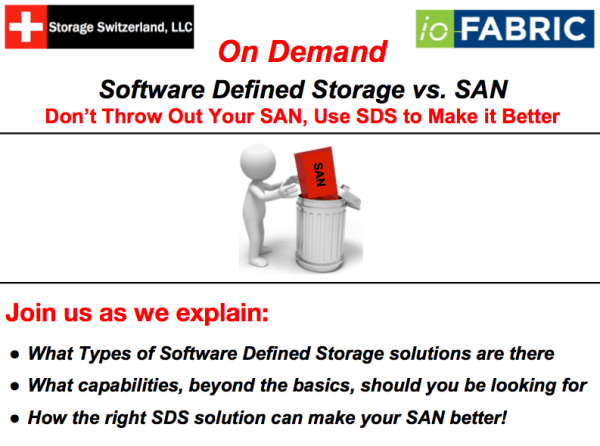
Watch On Demand

George Crump is the Chief Marketing Officer at VergeIO, the leader in Ultraconverged Infrastructure. Prior to VergeIO he was Chief Product Strategist at StorONE. Before assuming roles with innovative technology vendors, George spent almost 14 years as the founder and lead analyst at Storage Switzerland. In his spare time, he continues to write blogs on Storage Switzerland to educate IT professionals on all aspects of data center storage. He is the primary contributor to Storage Switzerland and is a heavily sought-after public speaker. With over 30 years of experience designing storage solutions for data centers across the US, he has seen the birth of such technologies as RAID, NAS, SAN, Virtualization, Cloud, and Enterprise Flash. Before founding Storage Switzerland, he was CTO at one of the nation's largest storage integrators, where he was in charge of technology testing, integration, and product selection.


 StorageSwiss.com - The Home of Storage Switzerland