
Couchbase and Cassandra count on the active data set to be in RAM. To overcome the RAM limits of a single server and to make more compute available, the environments run in a cluster that aggregates the RAM and CPU resources. The challenge is RAM is expensive compared to memory alternatives like flash. It is also not as dense. That lack of density leads organizations to add nodes to the respective Couchbase and Cassandra clusters to meet the RAM capacity demands. But doing so wastes CPU resources. In this StorageShort we discuss these challenges in detail with Dr. Amit Golander, CTO of Plexistor.
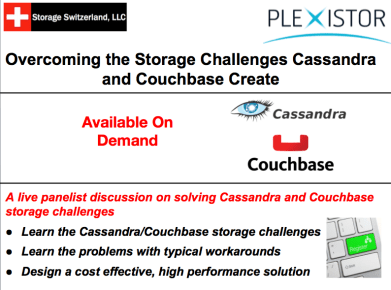
In our webinar, now available on-demand, Amit and I discuss not only the storage challenges that Couchbase and Cassandra present but also how to solve them. You can watch that webinar right now by clicking on the link below:
Watch On Demand
Finally, for details on the Plexistor technology itself, join us on the whiteboard for our ChalkTalk discussion “Maximizing the Potential of NVDIMM Storage Class Memory with Software Defined Memory“.

George Crump is the Chief Marketing Officer at VergeIO, the leader in Ultraconverged Infrastructure. Prior to VergeIO he was Chief Product Strategist at StorONE. Before assuming roles with innovative technology vendors, George spent almost 14 years as the founder and lead analyst at Storage Switzerland. In his spare time, he continues to write blogs on Storage Switzerland to educate IT professionals on all aspects of data center storage. He is the primary contributor to Storage Switzerland and is a heavily sought-after public speaker. With over 30 years of experience designing storage solutions for data centers across the US, he has seen the birth of such technologies as RAID, NAS, SAN, Virtualization, Cloud, and Enterprise Flash. Before founding Storage Switzerland, he was CTO at one of the nation's largest storage integrators, where he was in charge of technology testing, integration, and product selection.


 StorageSwiss.com - The Home of Storage Switzerland