
In response to a polling question in our recent webinar, “Why Data Migration Hurts And How To Stop the Pain,” 27 percent of the respondents indicated their biggest challenge was integrating on-premises storage with the cloud. While general data migration held the top spot, which is not a surprise given the title of the webinar, the fact that cloud integration scored so high was a surprise.
Interestingly, most organizations look at the cloud as something they should migrate to instead of integrate with. How can organizations integrate cloud storage into their existing storage strategy?
Data Should Flow to the Cloud
The problem for most data centers is they look at cloud storage as a dumping ground – similar to how they used to view tape. It is a place to park data when users do not need it or will never access it again. When IT views a storage repository as a dumping ground, migration is a more acceptable practice. It still is a pain to perform migration, but since it is, in theory, a one-time event, the perception is one of tolerance.
The problem with the perception that the cloud is a giant storage dumping ground is that it undersells the capabilities of cloud storage. Cloud storage offers so much more than tape; it is searchable, available for rapid recall, and even actionable in-place. All of which tape could never do.
Instead of being placed at the end of the chain, cloud storage should be integrated into the data center’s storage architecture. But integration requires data flows to and from the cloud instead of just migrating to it.
Making Data Flow Work
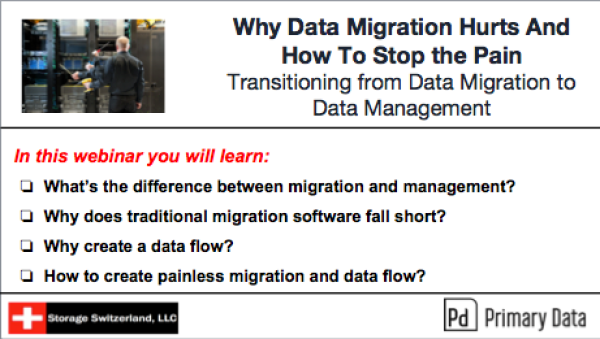
Creating a storage infrastructure where data flows seamlessly between various types of on-premises storage and cloud storage is the focus of our webinar, “Why Data Migration Hurts And How To Stop the Pain.” The key is flow control, something that will help IT consolidate their various storage resources, allow them to create policies on how data will move between those resources and present seamless access to data no matter where it is.
To learn more click here to watch the webinar.
Watch On Demand

George Crump is the Chief Marketing Officer at VergeIO, the leader in Ultraconverged Infrastructure. Prior to VergeIO he was Chief Product Strategist at StorONE. Before assuming roles with innovative technology vendors, George spent almost 14 years as the founder and lead analyst at Storage Switzerland. In his spare time, he continues to write blogs on Storage Switzerland to educate IT professionals on all aspects of data center storage. He is the primary contributor to Storage Switzerland and is a heavily sought-after public speaker. With over 30 years of experience designing storage solutions for data centers across the US, he has seen the birth of such technologies as RAID, NAS, SAN, Virtualization, Cloud, and Enterprise Flash. Before founding Storage Switzerland, he was CTO at one of the nation's largest storage integrators, where he was in charge of technology testing, integration, and product selection.


 StorageSwiss.com - The Home of Storage Switzerland