
As IT teams plan their infrastructure roadmaps for 2025, two major initiatives often surface: replacing aging Storage Area Networks (SANs) and exploring alternatives to VMware. While these projects might initially seem unrelated, there are compelling reasons to tackle them together. Coordinating a SAN replacement with a VMware exit can save time, reduce costs, and position your organization for a more scalable and efficient future.
The Perfect Storm: Why Both Projects Align
Legacy SAN Challenges
SANs have been a cornerstone of enterprise data storage for decades, but many organizations find that traditional SAN architectures no longer meet modern requirements. Common issues include:
- High Costs: Proprietary hardware and support contracts often come with significant price tags.
- Scalability Limitations: Adding capacity or improving performance can require costly upgrades or forklift replacements.
- Complexity: Managing SANs often requires specialized expertise, increasing operational overhead.
VMware Challenges
Simultaneously, VMware administrators are grappling with challenges that make alternative virtualization platforms more appealing:
- Licensing Costs: VMware’s pricing structure can strain budgets, especially as organizations scale.
- Broadcom Acquisition Concerns: Uncertainty about VMware’s roadmap under Broadcom has left many IT leaders questioning their long-term dependency.
- Evolving Needs: VMware-centric architectures can be less flexible when integrating new technologies like ultra-high-density drives or software-defined storage solutions.
Why Combine the Two Projects?
Shared Timelines
Both SAN replacement and VMware exit projects typically involve re-architecting IT environments. Consolidating both projects’ planning, migration, and implementation phases can minimize disruption and downtime.
Budget Efficiency
IT budgets are finite, and aligning these projects allows teams to prioritize investments strategically. For example, modern hyperconverged or ultraconverged platforms can simultaneously replace the SAN and VMware environments, reducing hardware and licensing costs.
Unified Infrastructure Goals
Addressing SAN and VMware together allows one to holistically modernize the entire IT stack. Organizations can adopt solutions that integrate storage, networking, and virtualization into a cohesive architecture, simplifying management and improving performance.
Key Considerations for Combined Projects
Evaluate Modern Alternatives
When replacing a SAN and exiting VMware, consider platforms that:
- Support high-performance storage and virtualization within a converged architecture.
- Allow you to leverage commodity hardware to reduce costs.
- Offer scalability and flexibility to adapt to future needs.
Migration Planning
Migrating both storage and virtualization environments requires careful planning to avoid business disruption. Prioritize tools and platforms that streamline migrations, such as those that support rapid, change block tracking migrations and conversions of both VMware VMs and SAN-based data.
Data Protection
Ensure that any new solution includes robust data protection features, but don’t treat these as simple “checkbox” items. Look for solutions that offer:
- Unlimited, ransomware-proof snapshots.
- Advanced replication capabilities that not only move data to a DR site but also encapsulate the entire data center, much like a VM encapsulates a virtual machine.
- Integrated networking capabilities such as BGP, enabling disaster recovery with just three mouse clicks and minimal last-minute configuration changes. See these DR capabilities in action by watching this on-demand webinar.
Staff Training
Shifting away from legacy systems requires a knowledge transfer. Look for alternative solutions that are conceptually similar to VMware, where a VM is still referred to as a VM, and a storage volume is still referred to as a volume. This minimizes the learning curve for IT staff. Also, ensure that the new platform offers 24×7 support that is not outsourced, so your team always has reliable assistance when needed.
The Benefits of Coordinating SAN Replacement and VMware Exit
By tackling both projects simultaneously, organizations can unlock several benefits:
- Reduced Complexity: Consolidating platforms streamlines infrastructure and operations.
- Cost Savings: Modern solutions often reduce hardware, licensing, and support costs.
- Future-Readiness: A unified, modern architecture positions IT teams to adopt emerging technologies more quickly.
Conclusion
A SAN replacement and VMware exit are significant undertakings, but approaching them together can lead to a more cohesive, cost-effective, and scalable infrastructure. By aligning these projects, organizations can modernize their IT environments, reduce dependencies on legacy systems, and better prepare for the future of IT.
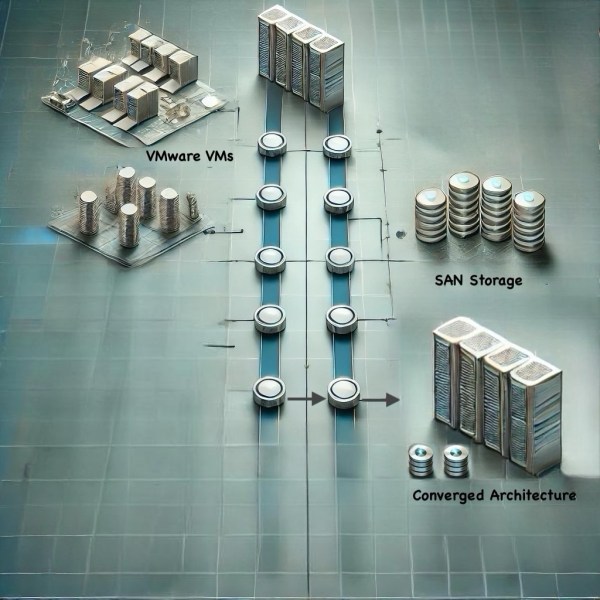
VergeIO’s VergeOS is a prime example of a solution that enables IT teams to tackle both projects at once. With VergeOS, you can seamlessly migrate virtual machines (VMs) from your existing storage array into a converged architecture while simultaneously converting VMware VMs into VergeOS VMs. Its storage services support modern ultra-high-density drives, such as Solidigm’s 122TB drives, delivering similar performance and advanced storage features as high-end dedicated storage arrays. VergeOS simplifies these transitions, making it an ideal choice for organizations seeking to modernize their infrastructure and reduce complexity.

George Crump is the Chief Marketing Officer at VergeIO, the leader in Ultraconverged Infrastructure. Prior to VergeIO he was Chief Product Strategist at StorONE. Before assuming roles with innovative technology vendors, George spent almost 14 years as the founder and lead analyst at Storage Switzerland. In his spare time, he continues to write blogs on Storage Switzerland to educate IT professionals on all aspects of data center storage. He is the primary contributor to Storage Switzerland and is a heavily sought-after public speaker. With over 30 years of experience designing storage solutions for data centers across the US, he has seen the birth of such technologies as RAID, NAS, SAN, Virtualization, Cloud, and Enterprise Flash. Before founding Storage Switzerland, he was CTO at one of the nation's largest storage integrators, where he was in charge of technology testing, integration, and product selection.


 StorageSwiss.com - The Home of Storage Switzerland