
A VMware exit is more than a licensing event; it is the time to revisit VDI. It is an opportunity for IT leaders to reassess their infrastructure strategy. Most plan to treat it as a hypervisor replacement, but that narrow view risks missing a bigger opportunity.
Exiting VMware creates a natural inflection point to revisit virtual desktop infrastructure (VDI). Today, the cost of implementing VDI has decreased significantly, while the pressures of compliance, security, ransomware defense, and AI-driven data governance have altered the equation. The same decisions driving a move away from VMware also open the door to rethinking how desktops are delivered.
This is not the time to trade one silo for another. The smarter path is to view a VMware exit and VDI reconsideration as part of one modernization strategy—consolidating desktops, servers, storage, and networking into a unified architecture.
Why VDI Was Often Dismissed
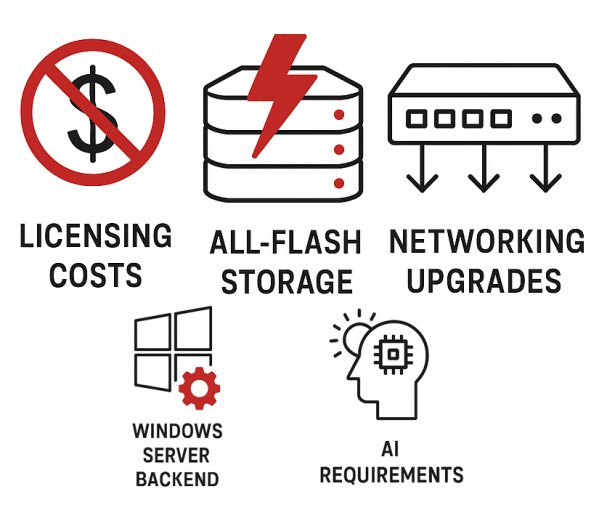
For many IT teams, early experiences with virtual desktop infrastructure left a negative impression. Traditional platforms required multiple management consoles, Windows Server back ends, and costly licensing models that grew faster than user adoption.
Deployments often demanded expensive storage and networking upgrades to support performance at scale. The result was higher costs and increased complexity compared to the physical desktops that VDI was meant to replace.
Due to these challenges, many organizations have limited VDI to small pilots, specific use cases, or abandoned it altogether. For years, the prevailing view was that VDI added more burden than benefit.
New Drivers for Reconsidering VDI
Conditions have shifted. The same obstacles that once made VDI unattractive are now less of a barrier, while new priorities have emerged.
Compliance and security requirements continue to rise. Centralizing desktops improves control over access policies and data handling, making it easier to meet regulatory standards.
Ransomware attacks have grown more frequent and more damaging. Managing thousands of endpoints separately increases the attack surface, while VDI brings desktops under consistent protection policies.
AI-driven initiatives add another layer of urgency. Training or prompting models with organizational data requires strict control over where that data resides. A consolidated architecture enables the delivery of AI as a shared service, pooling GPUs across workloads and distributing inference capacity where needed. This keeps sensitive data internal while providing desktops with secure access to AI-driven insights, eliminating the need for public cloud services.
Combined with lower implementation costs and simplified platforms, these pressures give IT leaders strong reasons to revisit VDI as part of a broader modernization strategy.
Storage and VDI Economics
Storage has always been one of the biggest obstacles to virtual desktop adoption. Dedicated all-flash arrays delivered the performance that VDI required, but the cost per desktop was often prohibitive. Many organizations abandoned projects when they realized the scale of investment needed for the necessary enterprise-class storage.
Legacy vSAN technology appeared to offer relief by allowing IT teams to use shelf SSDs, but its architecture introduced new limitations. Running storage as a virtual machine created overhead and performance gaps that became visible during boot storms and large-scale login events. VDI environments needed performance consistency that legacy vSAN struggled to provide.
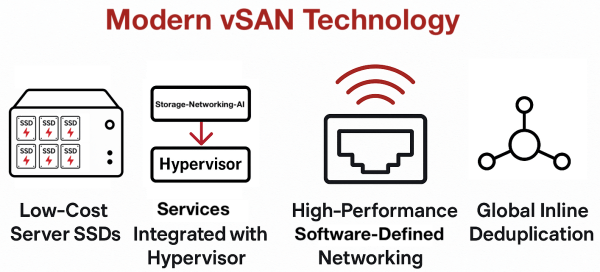
Modern-day vSAN technology takes a different approach. Instead of running storage as a VM, it integrates directly into the infrastructure operating system alongside the hypervisor, networking software, and private AI services. This design treats storage as a first-class citizen, delivering the performance of a dedicated all-flash array at a fraction of the cost. In practice, organizations achieve desktop performance equivalent to that of enterprise storage with economics that are 10 times better.
For IT leaders rethinking both virtualization and VDI, storage no longer has to be the barrier it once was. It becomes a cornerstone of a consolidated platform that delivers scale, performance, and affordability together.
The Case for Infrastructure-Wide Consolidation
A VMware exit often begins as a licensing or renewal issue, but the decisions made during that process have a ripple effect across the entire data center. Treating the moment as only a hypervisor replacement locks in the same complexity that created the current challenges.
Desktops, servers, storage, and networking operate too closely together to be modernized in isolation. Point solutions may solve immediate pain but leave behind silos, fragmented management, and hidden costs. Replacing VMware without addressing desktops or storage creates the same fractured architecture under a new brand.
An infrastructure-wide consolidation strategy eliminates those silos. By aligning VDI with virtualization, storage, and networking, IT leaders can simplify operations rather than replicating the complexity of the past. The result is a single architecture that lowers cost, improves resiliency, and prepares organizations for AI-driven workloads.
For VAR solution architects, this approach transforms the way conversations are conducted. Instead of pitching a hypervisor replacement, they can position a modernization plan that solves multiple problems at once and deepens long-term customer relationships. If you are a VAR and want to learn more about the advantages of presenting VDI to your customers, sign up for VergeIO and Inuvika’s upcoming live webinar this Thursday at 9:00 AM ET.
Old Thinking vs. New Thinking
| Question | Old Thinking: Hypervisor Swap | New Thinking: Infrastructure-Wide Consolidation |
|---|---|---|
| Scope of Change | Servers only | Desktops, servers, storage, networking unified |
| View of VDI | Too costly, too complex | Simplified, affordable, integrated into core IT |
| Storage Approach | Separate arrays or legacy vSAN | Integrated, first-class, 10X lower cost |
| Risk Posture | Fragmented, endpoint-heavy | Centralized, consistent, ransomware-resilient |
| Future Readiness (AI) | Limited, external cloud dependence | Private AI shared across workloads securely |
The Role of VergeIO, Inuvika, and Cirrus Data
Making consolidation real requires platforms designed to unify, not loosely integrate. VergeOS, Inuvika, and Cirrus Data collectively provide the building blocks for modernizing VDI and infrastructure as part of a unified strategy.
VergeOS delivers server virtualization, storage, networking, and resiliency in a single code base. Licensing is per server, not per core, eliminating Broadcom’s cost escalation model. Its integrated design makes storage a first-class citizen, providing the performance of dedicated all-flash arrays at a fraction of the price. VergeOS also now incorporates AI as a shared service, allowing organizations to distribute GPU resources across workloads while keeping sensitive data internal.
Inuvika provides a Linux-based VDI platform that is independent of Windows Server. Its concurrent-user licensing model aligns with real-world usage patterns, and its lightweight footprint reduces both deployment time and operational overhead. When paired with VergeOS, desktops and applications run on the same unified infrastructure as servers and storage.
Cirrus Data simplifies the migration process. Many organizations still run workloads across a mix of legacy systems, and moving them can feel daunting. Cirrus Data provides efficient, low-risk mobility that brings those workloads into VergeOS clusters without extended downtime or disruption.
Together, these platforms replace fragmentation with a unified architecture. For IT professionals, that means desktops and infrastructure delivered from the same resilient platform. For VAR solution architects, it creates a modernization story that addresses immediate VMware exit pressures while positioning customers for long-term success.
Readiness Questions for IT Professionals
Every VMware exit forces change, but not every organization recognizes the full extent of the opportunity. These questions help determine whether it’s time to treat VDI and infrastructure modernization as a single strategy, rather than separate projects.
- Have rising licensing costs already forced you to rethink your virtualization plans?
- Do compliance or audit requirements highlight gaps in how desktops and data are managed today?
- Has ransomware or endpoint sprawl made your current desktop model harder to secure?
- Are AI initiatives underway that require keeping organizational data internal, rather than sending it to a public cloud?
- Does your IT team spend more time maintaining silos than delivering new services?
If the answer is “yes” to several of these, then the VMware exit is more than a hypervisor swap. It is the right time to consolidate desktops, servers, storage, and networking into a unified platform that reduces cost and risk while preparing for future demands.
Next Steps
A VMware exit should not be treated as a narrow hypervisor replacement. It is the moment to modernize VDI and infrastructure together, eliminating silos and preparing for the demands of compliance, security, and AI.
For IT professionals, the opportunity lies in simplifying operations and reducing costs with a unified architecture. For VAR solution architects, it presents a chance to lead with strategy rather than products and build longer-term customer relationships.
The next step is clear. Join our upcoming webinars to see real-world examples of how VergeOS, Inuvika, and Cirrus Data deliver this strategy:
- Infrastructure + VDI Replacement: The Complete Partner Opportunity – Learn how unified infrastructure and modern VDI create larger, more profitable opportunities.
- After the VMware Exit – How to Consolidate, Repatriate, and Prepare for AI – Discover how consolidation goes beyond hypervisors to deliver performance, cost savings, and private AI readiness.
Ready to see how this strategy applies to your environment? Schedule a strategic planning session for a whiteboard overview of how consolidation will transform your desktops and infrastructure.

George Crump is the Chief Marketing Officer at VergeIO, the leader in Ultraconverged Infrastructure. Prior to VergeIO he was Chief Product Strategist at StorONE. Before assuming roles with innovative technology vendors, George spent almost 14 years as the founder and lead analyst at Storage Switzerland. In his spare time, he continues to write blogs on Storage Switzerland to educate IT professionals on all aspects of data center storage. He is the primary contributor to Storage Switzerland and is a heavily sought-after public speaker. With over 30 years of experience designing storage solutions for data centers across the US, he has seen the birth of such technologies as RAID, NAS, SAN, Virtualization, Cloud, and Enterprise Flash. Before founding Storage Switzerland, he was CTO at one of the nation's largest storage integrators, where he was in charge of technology testing, integration, and product selection.


 StorageSwiss.com - The Home of Storage Switzerland