
Dell has signaled that VxRail, as a product line, has lost its strategic relevance within its portfolio, prompting IT professionals to consider the VxRail exit options. Broadcom’s licensing changes created the catalyst, but the infrastructure reality runs deeper. Organizations running production workloads on VxRail hardware need to evaluate four distinct paths forward, each with different cost structures, migration complexity, and operational outcomes.
Key Takeaways
- VxRail customers face four distinct paths forward, each with different cost structures, migration complexity, and operational outcomes
- Maintaining the VxRail status quo delays the inevitable transition while costs increase and Dell’s strategic investment decreases
- Most hypervisor alternatives force organizations to purchase external storage arrays, turning a software migration into a multi-phase infrastructure project
- Dell Private Cloud requires new hardware, external storage systems, and continues VMware dependency in the near term
- Private cloud OS platforms like VergeOS preserve existing VxRail hardware, simplify migration execution, and unify infrastructure management
- Organizations should evaluate options based on infrastructure preservation, migration execution risk, and post-transition operational simplification
The choice matters now. Deferring the decision only narrows the options as hardware ages, support contracts expire, and the gap between current infrastructure and business requirements widens. Each path carries different implications for existing hardware investments, operational continuity during transition, and the infrastructure’s ability to support future workload requirements.
Key Terms
VxRail
Dell’s converged infrastructure platform combining VMware virtualization with integrated storage and networking in pre-configured appliances. Dell has shifted strategic focus away from VxRail toward Dell Private Cloud.
Private Cloud OS
An operating system architecture that unifies virtualization, storage, networking, and data protection in a single codebase rather than coordinating separate products through orchestration layers.
Dell Private Cloud
Dell’s platform positioning orchestrated multi-product deployments as private cloud. Requires external storage (primarily PowerStore) and currently supports only VMware as a fully validated hypervisor.
Node-by-Node Migration
A migration approach where individual servers are removed from the existing cluster one at a time, reconfigured with new software, and added to the growing replacement cluster. Maintains business continuity throughout the transition.
Stranded Assets
Infrastructure components that become unusable when transitioning to new platforms. VxRail internal SSDs become stranded when Dell Private Cloud requires external storage arrays.
Option 1: Maintain the VxRail Status Quo
The first option is to keep running VxRail in its current configuration by continuing to purchase VMware and vSAN licenses while paying Dell for hardware maintenance. This path offers familiarity and avoids migration risk, but it builds on a foundation that Dell itself has essentially deprecated from a strategic standpoint.
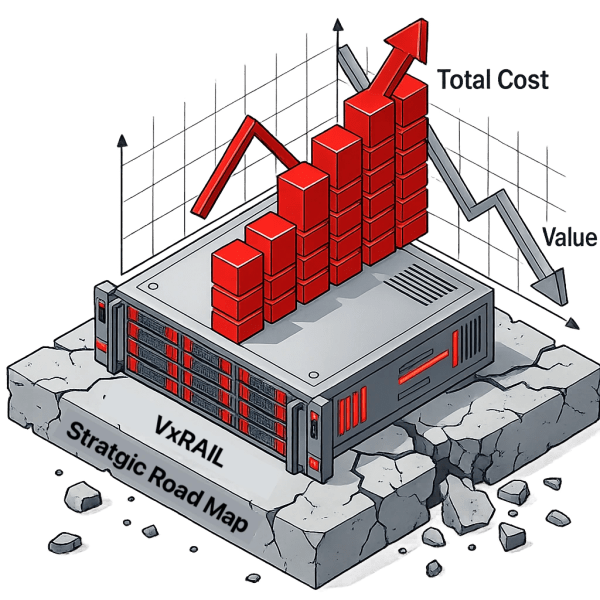
Dell has made its position clear through its shift toward Dell Private Cloud and seems to have reduced investment in VxRail-specific development. The product still exists in their portfolio, but it no longer represents their vision for converged infrastructure. Organizations choosing this path accept that they’re running on a platform whose vendor has moved strategic focus elsewhere.
The economics of this option have also deteriorated. Broadcom’s VMware licensing changes mean higher software costs for the same capability. Dell maintenance pricing for hardware that falls outside their current strategic products tends to climb over time. The combination creates a cost structure that increases while the underlying platform receives diminishing engineering investment and roadmap development.
This path delays the decision rather than resolving it. Hardware eventually reaches the end of life, components fail and become harder to source, and the infrastructure falls further behind operational requirements. The longer organizations wait, the more constrained their options become when they finally face the inevitable transition.
Option 2: Hypervisor Migration with Storage Replacement
The second path involves exiting VMware and vSAN by migrating to an alternative hypervisor and adopting a different storage architecture. This approach addresses the VMware licensing issue directly by replacing it with alternatives like Proxmox, XCP-ng, or other open-source or commercial hypervisors.
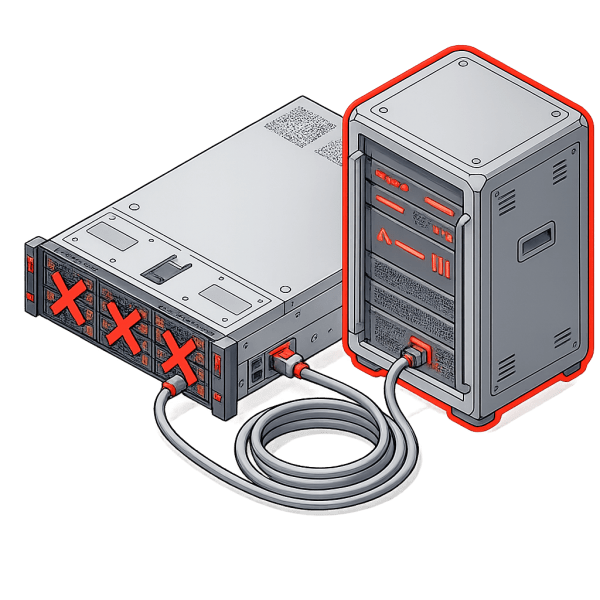
The challenge surfaces immediately when teams examine storage alternatives and hardware compatibility. Most hypervisor alternatives don’t support existing VxRail hardware configurations or lack integrated storage capabilities comparable to vSAN. This forces organizations into a storage decision that typically leads to the purchase of external arrays, introducing new infrastructure components with their own management overhead, lifecycle requirements, and operational complexity.
The migration itself becomes more complex when storage moves from integrated vSAN to external arrays. Data has to be migrated from internal SSDs to the new storage platform, which means extended migration windows, parallel infrastructure during the transition, and careful coordination between the compute and storage migration phases. The business continuity risk increases when migrations span multiple infrastructure layers that must be synchronized.
Organizations pursuing this path often discover they’ve traded VMware licensing costs for storage hardware costs, replaced vSAN operational simplicity with array management complexity, and extended their migration timeline across multiple projects. The alternative hypervisor might cost less than VMware, but the total solution, including storage, migration services, and extended parallel infrastructure operation, can exceed the initial cost projections.
Option 3: Dell Private Cloud Platform
Dell positions Dell Private Cloud as the strategic replacement for VxRail, but the transition represents more than a software upgrade. The platform shifts Dell’s architectural approach from converged infrastructure to orchestrated multi-product deployments with external storage requirements.
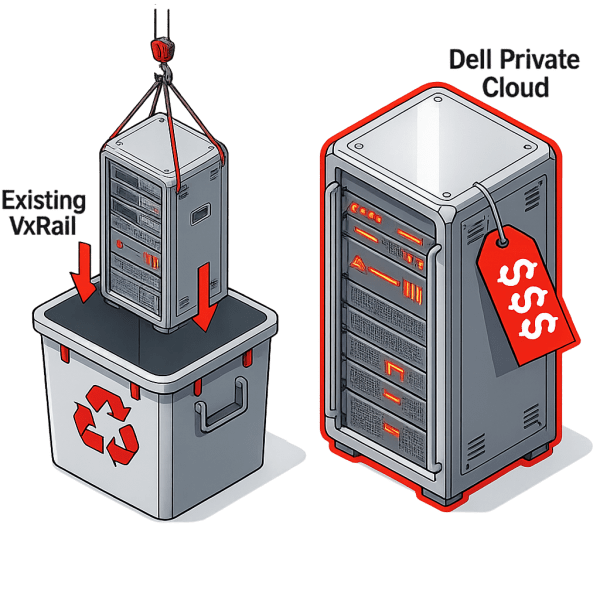
Dell Private Cloud moves away from vSAN’s converged storage model toward external Dell storage platforms, primarily PowerStore. This means VxRail customers can’t simply migrate their existing deployments forward. Internal SSDs that currently store production data become stranded assets. Organizations need to purchase new external storage systems and adopt fundamentally different storage operational models.
The hypervisor situation adds uncertainty to the evaluation. Dell Private Cloud currently supports only VMware as a fully validated hypervisor option. Nutanix AHV and Red Hat OpenShift support remain in development. Organizations seeking immediate relief from VMware licensing costs can’t get it through Dell Private Cloud without continuing to run VMware during an extended transition period.
Hardware compatibility presents another variable. Dell hasn’t stated that existing VxRail servers qualify for Dell Private Cloud deployments. Documentation emphasizes new server purchases and new configurations. Organizations should plan for hardware refresh as part of the Dell Private Cloud transition rather than assuming their current VxRail investment carries forward.
The platform itself remains relatively new in the market. Dell’s claims about automation capabilities and operational simplification haven’t been validated through years of production deployment across diverse environments. Organizations choosing this path accept that they’re implementing a platform whose operational characteristics and long-term viability are still being proven in real-world conditions.
Option 4: Private Cloud OS Architecture
The fourth path involves replacing VxRail with a private cloud OS that unifies virtualization, storage, and networking in a single codebase rather than coordinating separate products through orchestration layers. This approach changes the architectural foundation instead of just swapping vendors or products within the same fragmented infrastructure model.
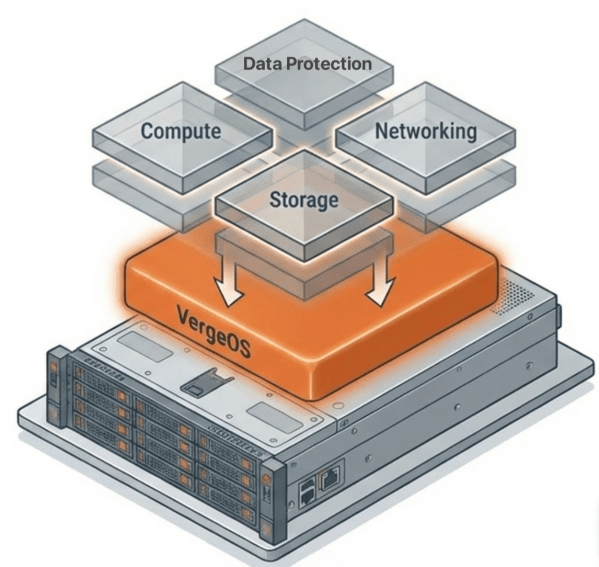
A private cloud OS like VergeOS controls compute, storage, networking, and data protection through integrated code that treats all resources as elements of a single platform. This eliminates the product coordination overhead of managing separate hypervisors, storage systems, and network configurations with different management interfaces and lifecycle schedules.
The hardware economics shift favors preserving infrastructure over replacing it. VergeOS runs directly on existing VxRail servers and continues to use internal SSDs for distributed storage. Organizations like Alinsco Insurance and others have validated this approach, preserving their hardware investments for years while simultaneously exiting both VMware and vSAN. Performance frequently improves on the same hardware once the overhead from coordinating multiple products is replaced by unified platform control.
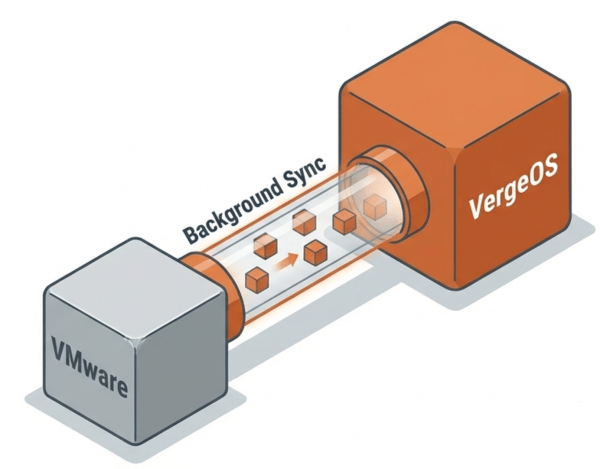
Migration happens through built-in VMware compatibility rather than through third-party tools or manual rebuild processes. The platform connects directly to VMware environments and migrates workloads via background synchronization, keeping production systems online during the transition. Organizations can complete migrations during normal business hours without scheduled downtime or extended maintenance windows.
The operational model simplifies to managing one system instead of coordinating multiple infrastructure products. Updates, capacity planning, performance optimization, and troubleshooting are managed through a unified platform rather than through separate vendor tools and support contracts. The infrastructure becomes easier to operate, not just cheaper to license.
Future workload support comes from platform architecture rather than from bolted-on capabilities. Container support, AI workload optimization, and emerging infrastructure requirements get addressed through the same unified codebase that handles traditional virtualization. Organizations don’t add products to gain capabilities. They gain capabilities through platform evolution.
Evaluating VxRail Exit Criteria
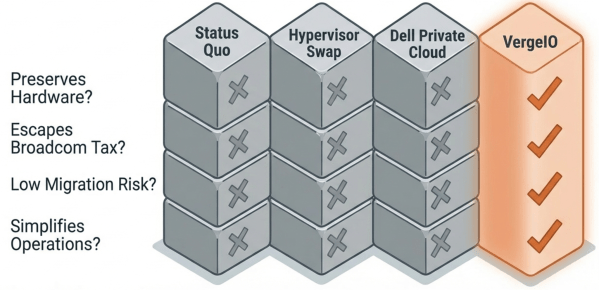
VxRail customers should evaluate these options against three criteria that determine long-term viability: preservation of existing infrastructure, migration execution risk, and operational simplification after the transition is complete.
Existing infrastructure preservation matters for budget reasons and for timeline reasons. Options that require new hardware purchases add cost and extend deployment schedules. Options that strand internal storage capacity waste investments that still have useful life remaining.
Migration execution risk determines whether an exit happens on schedule or stalls in extended parallel operation. Options that require multi-phase migrations across separate storage and compute projects introduce more failure points and longer transition periods. Options with built-in migration capabilities reduce execution risk and accelerate timelines.
Operational simplification after transition separates true infrastructure improvements from cost-shifting exercises. Options that reduce the number of products to manage deliver ongoing operational benefits. Options that replace one fragmented stack with another fragmented stack under different vendor names merely defer complexity rather than eliminate it.
VxRail customers face a genuine decision point, not just a renewal negotiation. The infrastructure needs to evolve regardless of which path teams choose. The question is whether that evolution happens through product substitution within the same architectural model or through a shift to private cloud platforms designed from the start to operate as unified systems.
Frequently Asked Questions
Can I continue running VxRail indefinitely?
Technically yes, but the economics deteriorate over time. Dell has shifted strategic focus away from VxRail, Broadcom’s VMware licensing increases costs, and Dell maintenance pricing for non-strategic products tends to climb. Hardware eventually reaches end of life, making this a delayed decision rather than a long-term solution.
Why do most hypervisor alternatives require new storage?
Most alternative hypervisors don’t support VxRail hardware configurations or lack integrated storage capabilities comparable to vSAN. This forces organizations to purchase external storage arrays, which adds cost and complexity while stranding the internal SSDs in existing VxRail servers.
Does Dell Private Cloud work with existing VxRail hardware?
Dell hasn’t stated that existing VxRail servers qualify for Dell Private Cloud deployments. Documentation emphasizes new server purchases and new configurations. Organizations should plan for hardware refresh as part of the Dell Private Cloud transition.
What happens to VxRail internal SSDs with Dell Private Cloud?
Dell Private Cloud moves away from converged storage toward external Dell storage platforms (primarily PowerStore). Internal SSDs that currently store production data become stranded assets. Organizations need to purchase new external storage systems and adopt different storage operational models.
Can I exit VMware immediately with Dell Private Cloud?
No. Dell Private Cloud currently supports only VMware as a fully validated hypervisor option. Nutanix AHV and Red Hat OpenShift support remain in development. Organizations seeking immediate relief from VMware licensing costs can’t get it through Dell Private Cloud without continuing to run VMware during an extended transition period.
How does a private cloud OS preserve existing VxRail hardware?
Private cloud OS platforms like VergeOS run directly on existing VxRail servers and continue to use internal SSDs for distributed storage. The software replaces VMware and vSAN without requiring new hardware purchases. Organizations migrate through a node-by-node process that maintains business continuity while repurposing existing infrastructure.
What is node-by-node migration?
Node-by-node migration removes servers from the existing VMware cluster one at a time, installs new software on each removed node, and adds it to the growing replacement cluster. Production systems stay online throughout the transition. Organizations can complete migrations during normal business hours without scheduled downtime.
How do I evaluate which VxRail exit path is right for my organization?
Evaluate options against three criteria: existing infrastructure preservation (can you keep your hardware and internal storage), migration execution risk (how many phases and projects are required), and operational simplification after transition (does the new platform reduce or maintain infrastructure product count). Options that preserve infrastructure, reduce migration phases, and simplify operations deliver better long-term outcomes than options that require hardware refresh, multi-phase migrations, and product proliferation.

George Crump is the Chief Marketing Officer at VergeIO, the leader in Ultraconverged Infrastructure. Prior to VergeIO he was Chief Product Strategist at StorONE. Before assuming roles with innovative technology vendors, George spent almost 14 years as the founder and lead analyst at Storage Switzerland. In his spare time, he continues to write blogs on Storage Switzerland to educate IT professionals on all aspects of data center storage. He is the primary contributor to Storage Switzerland and is a heavily sought-after public speaker. With over 30 years of experience designing storage solutions for data centers across the US, he has seen the birth of such technologies as RAID, NAS, SAN, Virtualization, Cloud, and Enterprise Flash. Before founding Storage Switzerland, he was CTO at one of the nation's largest storage integrators, where he was in charge of technology testing, integration, and product selection.


 StorageSwiss.com - The Home of Storage Switzerland
Hello George – I tried to reach out to you on LinkedIn in regards to this article. I have 7+ years experience designing & installing VxRail solutions & would be a great asset to your team if you are successfully gaining enough business in this area. Please contact me at denniscoldicott@gmail.com or 586.405.8860 if I can be of any assistance.