
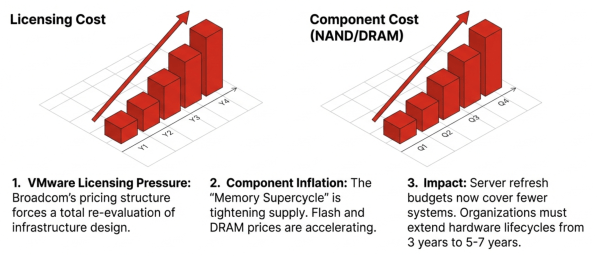
The case for revisiting private cloud strengthens as multiple infrastructure pressures converge. VMware licensing costs continue climbing. Flash and DRAM prices continue to rise as the memory supercycle tightens supply. Server refresh budgets are strained by component cost inflation, while server supply itself becomes constrained. Organizations that dismissed private cloud as marketing hype now face the economic reality that demands a reconsideration of their architecture.
Key Takeaways
- Private cloud failed initially because the industry conflated virtualization with true private cloud and built orchestrated stacks that coordinated separate products rather than integrating them
- Converged infrastructure appliances like VxRail and vBlock simplified procurement but created vendor lock-in and eliminated hardware flexibility
- Three converging forces make private cloud viable now: VMware licensing pressure, component cost inflation from the flash and memory supercycle, and technology maturity enabling integrated platforms
- True private cloud requires kernel-level integration of virtualization, storage, networking, and data protection rather than API coordination layers
- Hardware abstraction must support mixed vendors and generations, enabling organizations to extend server life by 2-5 years during component price inflation
- Orchestrated private clouds accumulate complexity over time while integrated private cloud operating systems reduce operational burden as infrastructure grows
- Hypervisor swaps address VMware licensing but preserve fragmented architecture requiring coordination across storage, networking, and data protection tiers
- Integrated platforms like VergeOS consolidate four data center tiers into one system, turning hardware longevity from theoretical advantage into realized cost reduction
Revisiting the Private Cloud Promise
The original promise of private cloud was compelling. Infrastructure would become software-controlled in ways that eliminated hardware dependencies and vendor lock-in. The platform would manage virtually any combination of hardware from any vendor of any generation, turning procurement into an economic optimization rather than a compatibility exercise. Even the smallest data center with three or four servers would operate with service provider capabilities that were previously exclusive to organizations running hundreds of systems. Specialization within IT disciplines would fade as teams managed a single platform
rather than coordinating expertise across storage, virtualization, networking, and data protection silos. The promise was consolidation and simplification at a structural level.
.
Key Terms
- Private Cloud
- Infrastructure that virtualizes compute, storage, networking, and data protection as unified capabilities managed through a single control plane, extending abstraction beyond server virtualization to the entire data center stack.
- Virtualization
- Technology that abstracts physical servers into virtual machines using a hypervisor, representing one component of infrastructure rather than a complete private cloud system.
- Orchestrated Private Cloud
- Architecture that coordinates separate products (storage, hypervisor, networking) through automation layers and management overlays, masking complexity rather than eliminating it through integration.
- Integrated Private Cloud OS
- Platform that consolidates virtualization, storage, networking, and data protection into a single code base with kernel-level integration, treating infrastructure functions as native operating system capabilities.
- Converged Infrastructure
- Pre-validated bundles of compute, storage, and networking components (like VxRail and vBlock) that simplify procurement but create vendor lock-in and eliminate hardware flexibility through certification matrices.
- Hardware Abstraction
- Platform capability to treat physical servers as pooled capacity rather than individual systems requiring specific configurations, supporting mixed vendors, generations, and gradual refresh cycles without compatibility constraints.
- Memory Supercycle
- Period of sustained component price inflation driven by supply constraints and demand growth, affecting flash NAND and DRAM pricing while extending server refresh cycles from economic necessity.
- Kernel-level Integration
- Deep architectural integration where infrastructure functions share code, data structures, and operational models at the operating system core rather than coordinating through API layers or management interfaces.
Why Private Cloud Failed the First Time
Virtualization Is Not Private Cloud
The first problem was definitional. The industry conflated virtualization with private cloud, treating hypervisors that carve physical servers into virtual machines as equivalent to infrastructure that virtualizes the entire stack. The distinction matters in ways that became apparent only after organizations discovered that calling VMware a private cloud was like calling a car engine a car. Virtualization abstracts compute as one component of infrastructure. Private cloud abstracts compute, storage, networking, and data protection as unified capabilities managed through a single control plane.
Orchestrated Stacks Cannot Deliver Integration
The second problem was architectural, stemming from how the industry built what it marketed as a private cloud. These systems were assembled from stacks of separate code developed by different companies or different departments within the same company operating in different locations. Storage came from a single vendor, with its own development team and release schedule. Virtualization came from another vendor with different architectural assumptions. Networking came from a third vendor optimizing for different use cases. Data protection bolted on as an afterthought from yet another vendor or internal team. Organizations wrapped a management GUI over the stack and added automation tooling to coordinate workflows across these independent products, then called the result “cloud” on the basis that the GUI created the illusion of unity.
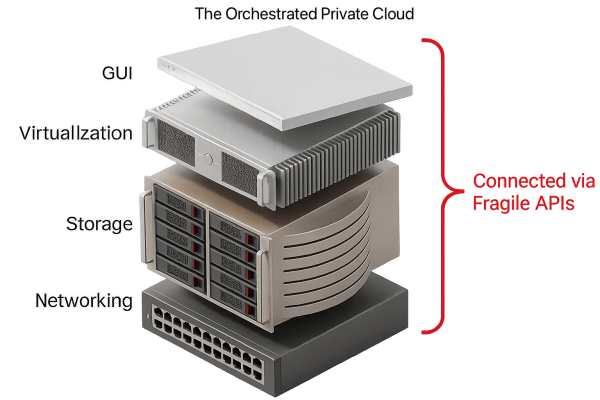
The illusion collapsed under operational reality. Upgrades required coordinating firmware across products developed on different timelines by different teams. Failures cascaded across component boundaries in ways that no single vendor could diagnose or resolve. Troubleshooting required expertise in multiple vendor platforms, and teams spent more time managing relationships between products than managing actual workloads. Complexity accumulated as the stack grew, compounding the operational burden that the private cloud was supposed to reduce.
Converged Infrastructure Created Lock-In
Vendors responded by bundling components into converged infrastructure appliances, with VxRail and vBlock exemplifying the approach. The bundling simplified procurement by reducing the number of vendor relationships and the integration effort required to validate specific hardware and software combinations. The tradeoff was lock-in and cost inflation. Organizations paid premiums for vendor-certified configurations, losing the ability to mix hardware based on workload requirements or budget constraints. The private cloud promise of hardware flexibility disappeared behind vendor certification matrices that dictated which servers worked with which storage arrays under which hypervisor versions.
The result is that most organizations running what they call a private cloud are actually using virtualization with a management layer or with some automation. Others abandoned the concept entirely and accepted that data centers will forever operate as four discrete tiers, each with its own products, lifecycle, and operational model. Teams coordinate across these tiers through manual processes or bolt-on automation that masks complexity without removing it.
What Changed
Three forces converge to make private cloud viable now in ways it wasn’t viable before, creating conditions that demand architectural reconsideration rather than incremental adjustment:
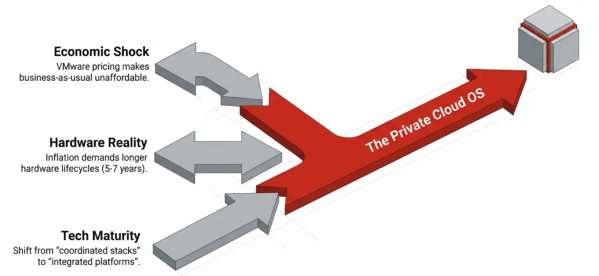
- VMware licensing pressure forces infrastructure reevaluation at a scope and speed that most organizations have not faced before. Organizations cannot simply absorb Broadcom’s pricing structure without rearchitecting workload placement and infrastructure design, and the forced change creates space to reconsider assumptions about how infrastructure should operate rather than just how it gets procured.
- Component cost inflation changes hardware economics in ways that alter refresh timelines and total cost calculations. Flash prices climb as NAND supply tightens under demand from AI workloads and mobile devices. DRAM costs accelerate as the memory supercycle reduces availability across consumer, enterprise, and data center markets. Server refresh budgets stretch to cover fewer systems than they did two years ago, and organizations that previously refreshed on three-year cycles now extend hardware life to four or five years out of financial necessity rather than preference.
- Technology maturity reaches a threshold that enables architectural approaches that were not viable a decade ago. The components that failed to deliver a true private cloud in the first wave now exist as integrated platforms rather than coordinated stacks. The distinction between orchestration and integration determines whether the private cloud delivers on its original promises or repeats previous failures under new marketing.
What Private Cloud Operating System Means
A private cloud requires an operating system that integrates virtualization, storage, networking, and data protection as native capabilities rather than as separate, coordinated products. The integration must run deep enough that these functions share code, share data structures, and share operational models at the kernel level rather than through API layers or management overlays. Surface-level integration through APIs recreates the coordination problem that undermined the first-generation private cloud, just with better tooling around the coordination.
The key requirements for a true private cloud operating system include:
- Deep integration at the kernel level where virtualization, storage, networking, and data protection share code and data structures rather than coordinate through APIs or management overlays. Surface-level integration recreates the coordination problem that undermined first-generation private cloud.
- Hardware abstraction that extends beyond virtualization, treating physical servers as pooled capacity rather than individual systems requiring specific configurations. The abstraction must support mixed hardware generations from multiple vendors, gradual refresh cycles that add new capacity without retiring old hardware, and procurement decisions based on price performance rather than platform certification requirements.
- Consolidated operational model that eliminates expertise silos rather than fragments knowledge across product domains. Teams should manage a single platform with a single interface and a single troubleshooting methodology, rather than coordinating knowledge across storage platforms, hypervisors, network infrastructure, and backup products.
- Server longevity through software abstraction that runs on commodity x86 servers purchased five to ten years ago, without sacrificing features or performance. Hardware refresh happens gradually as capacity requirements change, rather than through forklift upgrades driven by software compatibility matrices that declare older servers unsupported.
The economic benefit compounds when component prices inflate. Extending server life by two years saves capital that would otherwise be used to fund memory and flash purchases at prices 50% to 100% higher than during the last refresh.
| Dimension | Orchestrated Private Cloud | Integrated Private Cloud OS |
|---|---|---|
| Architecture | Separate products coordinated through automation | Single code base with native capabilities |
| Integration Level | API layers and management overlays | Kernel-level integration sharing code and data structures |
| Component Dependencies | Storage, hypervisor, networking as separate products | All functions as native OS capabilities |
| Upgrade Process | Coordinate across multiple products and timelines | Single rolling update for entire platform |
| Hardware Support | Vendor certification matrices required | Any commodity x86 from multiple vendors and generations |
| Operational Model | Expertise silos across storage, virtualization, networking | Single platform with unified troubleshooting |
| Complexity Over Time | Accumulates as coordination overhead grows | Decreases as platform consolidates functions |
| Failure Domains | Cascade across product boundaries | Contained within unified platform |
| Examples | Dell Private Cloud, traditional VMware stacks | VergeOS, integrated infrastructure OS platforms |
The Path Forward
Organizations facing VMware exits and component cost pressures should evaluate whether a hypervisor replacement alone solves the right problem or merely addresses the most visible symptom. Swapping VMware for another hypervisor addresses licensing costs but does not address the operational complexity of managing separate storage, networking, and data protection tiers. The fragmented architecture remains even when the hypervisor changes, and teams still coordinate across multiple products with different lifecycles and different failure modes.
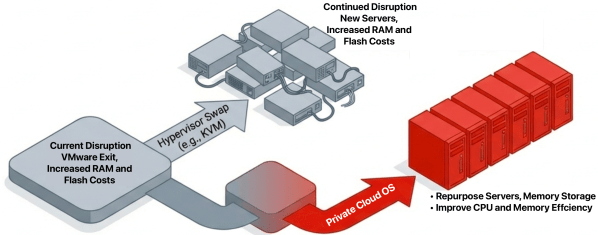
The alternative is to consolidate infrastructure into a platform that functions as an operating system rather than a coordinated stack. The platform must integrate the four data center tiers into a single codebase rather than coordinate them through automation layers. The platform must abstract hardware dependencies well enough to run on existing servers and across mixed hardware generations, rather than mandating specific vendor configurations. The platform must reduce operational complexity at a structural level rather than just coordinate it better through improved tooling.
The private cloud failed the first time not because of a lack of demand or vendor investment, but because of architectural choices that treated orchestration as equivalent to integration. Orchestration cannot deliver what integration provides, management layers cannot substitute for unified platforms, and bundled appliances cannot replace true hardware abstraction. The forcing functions that drive infrastructure reevaluation today create space for architectures that were not viable when private cloud first emerged.
VergeOS represents what private cloud operating systems look like when built as integrated platforms rather than orchestrated stacks, consolidating virtualization, distributed storage, networking, and data protection into a single codebase rather than coordinating separate products. Hardware abstraction runs deep enough to support commodity x86 servers from multiple vendors and multiple generations, and organizations install VergeOS on existing hardware to continue using servers that would otherwise require replacement under vendor-mandated refresh cycles. The operational model consolidates what were previously four discrete tiers into a single platform managed through a single interface, and teams that previously coordinated across storage arrays, hypervisors, and backup products now operate a single system with a single troubleshooting methodology and a single upgrade path. The economic benefit extends beyond licensing savings to capital avoidance when component prices inflate, turning hardware longevity from a theoretical advantage into a realized cost reduction.
Private cloud makes sense now in ways it did not before, and the question is whether organizations use the current disruption to rebuild the same fragmented architecture with different vendors, or to consolidate infrastructure into platforms that actually simplify operations.
Frequently Asked Questions
What’s the difference between virtualization and private cloud?
Virtualization abstracts physical servers into virtual machines using a hypervisor. Private cloud extends abstraction to the entire infrastructure stack, virtualizing compute, storage, networking, and data protection as unified capabilities managed through a single control plane.
Why didn’t private cloud succeed the first time?
The industry conflated virtualization with private cloud and built orchestrated stacks from separate products rather than integrated platforms. Converged infrastructure appliances simplified procurement but created vendor lock-in and eliminated hardware flexibility. Management GUIs masked complexity without eliminating it.
What changed to make private cloud viable now?
Three forces converge: VMware licensing pressure forces architectural reevaluation, flash and DRAM cost inflation makes hardware longevity critical, and technology maturity now enables truly integrated platforms rather than just orchestrated stacks.
What’s the difference between orchestrated and integrated private cloud?
Orchestrated private clouds coordinate separate products through automation layers and APIs. Integrated private cloud operating systems consolidate virtualization, storage, networking, and data protection into one code base with kernel-level integration. Orchestration masks complexity while integration eliminates it.
Can small organizations benefit from private cloud?
Yes. The original promise was that even the smallest data center with three or four servers would operate with service provider capabilities. Integrated private cloud platforms eliminate the expertise silos that small teams cannot maintain, consolidating operational knowledge into one platform.
How does hardware longevity reduce costs during component inflation?
Platforms with true hardware abstraction run on commodity x86 servers purchased five to ten years ago without sacrificing features or performance. Extending server life by two years saves capital that would otherwise fund memory and flash purchases at prices 50% to 100% higher than previous refresh cycles.
When should organizations choose hypervisor replacement over private cloud?
Hypervisor swaps address VMware licensing but preserve fragmented architecture requiring coordination across storage, networking, and data protection tiers. Organizations wanting to reduce infrastructure to one platform, one interface, and one operational model should evaluate integrated private cloud platforms instead.
What defines a true private cloud operating system?
Kernel-level integration of all infrastructure functions, hardware abstraction supporting mixed vendors and generations, consolidated operational model eliminating expertise silos, and server longevity extending infrastructure life without forklift refresh requirements.

George Crump is the Chief Marketing Officer at VergeIO, the leader in Ultraconverged Infrastructure. Prior to VergeIO he was Chief Product Strategist at StorONE. Before assuming roles with innovative technology vendors, George spent almost 14 years as the founder and lead analyst at Storage Switzerland. In his spare time, he continues to write blogs on Storage Switzerland to educate IT professionals on all aspects of data center storage. He is the primary contributor to Storage Switzerland and is a heavily sought-after public speaker. With over 30 years of experience designing storage solutions for data centers across the US, he has seen the birth of such technologies as RAID, NAS, SAN, Virtualization, Cloud, and Enterprise Flash. Before founding Storage Switzerland, he was CTO at one of the nation's largest storage integrators, where he was in charge of technology testing, integration, and product selection.


 StorageSwiss.com - The Home of Storage Switzerland