
IT organizations are under pressure to deliver an always on experience to their users. In the Facebook and Google era, internal and external customers expect critical business applications to be available at all times. This means that planned or unplanned downtime is simply not an option. The challenge is that application high availability (HA) can be complex to integrate and manage and it can fall outside of IT’s budget.
Onsite and Offsite HA
In addition to application (HA), businesses also need a viable way to recover their operations in the event of a site disaster. This means that critical applications need to be nearly instantly recoverable in a secondary data center location. But if HA costs are high, then the costs for building out a redundant site with all the necessary hardware and software infrastructure can be expensive.
The Work-Around Challenge
To get around the exorbitant costs of building out a highly resilient clustered application environment that can do local and remote application failover, some IT planners will resort to using host based replication technology. The problem with this approach, however, is that recovering failed application requires manual intervention. For example, a physical or virtual machine will still need to be bootstrapped before the application can be recovered. Moreover, there will still be a need for redundant server and storage infrastructure to support failover to a remote site. In short, any realized savings may be minimal and it could come at the expense of meeting application service levels.
Some organizations are also considering CDP or continuous data protection technology to achieve low recovery time and recovery points (RTO/RPO) for their critical systems. But some of these offerings don’t provide support for physical servers and they often require scripting to automate failover capabilities.
Automated HA for the Masses
Businesses need intelligent HA solutions that can provide fully automated local and remote application failover utilizing either existing SAN storage capacity or even commodity, server-side disk. They also need solutions which can provide HA for physical servers and virtual machines. And if the solution can also leverage public cloud infrastructure, businesses can attain highly resilient application failover DR capabilities at a fraction of the cost of a dedicated offsite solution.
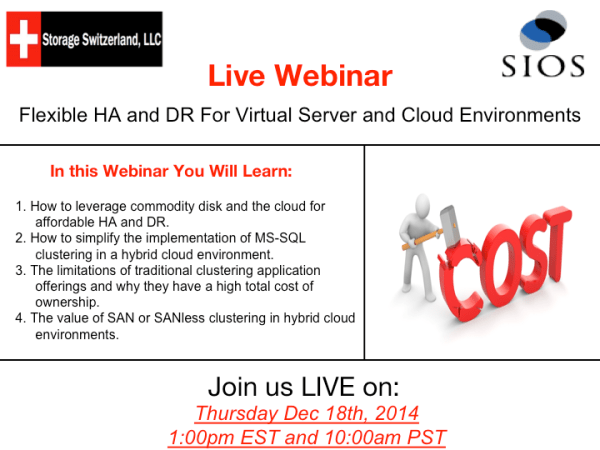
To learn more about how to integrate cost-effective application HA with local and cloud failover capabilities, join us for the webinar “Flexible HA for Virtual and Server Cloud Environments” on Thursday, December 18th at 1pm ET.
Click To Register
Click Here To Sign Up For Our Newsletter

As a 22 year IT veteran, Colm has worked in a variety of capacities ranging from technical support of critical OLTP environments to consultative sales and marketing for system integrators and manufacturers. His focus in the enterprise storage, backup and disaster recovery solutions space extends from mainframe and distributed computing environments across a wide range of industries.


 StorageSwiss.com - The Home of Storage Switzerland