
The Next Generation Data Center (NGDC) must contend with massive growth, not only in data capacity, but also in data criticality. Data in the NGDC must be protected and available in case something goes wrong. At the same time, IT personnel within these data centers are stretched very thin, they need tools that are not only easy to use and don’t need constant monitoring. But the tools they use must be more than just easy, they need to scale and perform well to keep up with this agile data center. Against this backdrop of challenges, Dell Software has recently updated their enterprise backup solution, NetVault Backup, to version 10.
Simplicity
The terms simplicity and enterprise software, especially enterprise backup software, are rarely used together. Enterprise backup software has been the poster child of the complex. Its reputation of being complex is no surprise given the task at hand; protecting data on a wide variety of operating systems and applications. But in the next generation data center, complexity has to be driven out. Complexity does not scale and IT staffs that are stretched thin don’t have the time to master complex tools.
Also IT staffs in these data centers typically have a variety of responsibilities, so they can’t spend inordinate amounts of time trying to master the intricacies of a convoluted backup product. In short, the software needs to be simple to use and intuitive enough for operators to master within a short period of time. Furthermore, they shouldn’t have to go through the learning curve all over again when they need to execute rarely performed tasks.
In version 10, NetVault tackles the issue of complexity head on, changing from a legacy motif style interface to a modern web based UI. Through its new configuration wizard, it quickly walks the user step by step through the various backup parameters so that backup jobs can be rapidly created. It also enables the user to configure common backup tasks with ease – such as, adding clients, installing application plug-ins and adding storage devices.
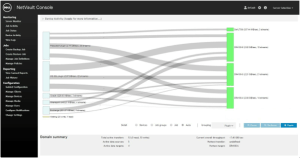 One area that NetVault particularly excels in is enabling backup administrators to determine how to balance backup job workloads. This is done in part through a new and unique visualization of backup performance. From a single screen, you can see how backup jobs are performing, what devices they are utilizing and how much bandwidth they require, all in real-time. Armed with this information, backup administrators can easily make decisions about job scheduling and routing so they can optimally use their backup architecture resources.
Scalability
One of the fundamental limitations with a data protection solution’s ability to scale with the environment is its own database; also known as backup meta-data. This database contains information about everything that is being protected like the name of the file, the data that is protected and the device or devices that the data is stored on. The ability to access this information is not only critical for recovery, but allows the backup team to validate that specific service level data protection objectives are being met.
Most enterprise backup applications started with a very rudimentary scheme for storing this information. In some cases, it was as simple as a text file; in others, it was simply a very basic database. While this construct was fine for data centers of the 90’s, the NGDC data center has far too many virtual and physical servers and far too many files to be tracked.
While NetVault has always had one of the better meta-data schemas, Dell wanted to improve scalability even further. NetVault Backup 10 has moved to a new backend database that increases scalability by 233%. This means that a single NetVault backup server with no other changes in hardware can support an environment three times the size of NetVault Backup 9.
The NetVault Backup 10 database is based on PostgreSQL. This provides an open database that not only performs well, but it is far more crash resistant than most proprietary database formats.
Performance
Interestingly, the database that an enterprise backup solution uses to maintain information about the backup also directly impacts performance of the environment. The speed at which this database can be updated directly impacts backup performance and the speed at which it can be read, impacts search and recovery operations. NetVault Backup 10’s new PostgreSQL database allows this routine to happen in real-time, causing no performance degradation to data transfers.
Another way that enterprise backup solutions can improve performance is to integrate with advanced backup hardware appliances. For example, NetVault Backup 10 integrates with the Dell DR Series of deduplication appliances to improve backup performance to up to 22TB per hour while maintaining dedupe ratios of greater than 90%.
NetVault 10 integrates with Dell’s DR appliance via Rapid Data Access (RDA) Technology. RDA is an API that enables NetVault to maintain end-to-end control of all the backup, restore and replication tasks, while allowing the DR appliance to maintain control over all the storage management tasks.
The Dell DR appliance is a purpose-built, disk backup appliance that uses deduplication technology that Dell acquired through its purchase of Ocarina Networks to significantly improve backup and recovery processes by reducing the amount of data that needs to be stored. It has built-in data-protection safeguards in both hardware and software to verify backup integrity. It is designed to ensure data protection in case of power loss and proactively detects corruption due to faulty hardware.
The Dell DR appliance offers improved disaster-recovery capability through deduplicated replication. Furthermore, through its many-to-one replication capability, it can consolidate multiple remote office backup workloads into a single, easy-to-manage solution, while reducing or eliminating the need for tape backups altogether.
RDA also allows backup clients to bypass the backup server for data transfer, saving a hop across the network. Essentially, data to be protected is transferred from the backup client directly to the DR Appliance while the meta-data is sent to the NetVault server so that its database can be updated. This capability should eliminate the need to do separate, independent application backups, now all backups can be done through NetVault and achieve maximum backup performance.
Summary
Enterprise backup in the Next Generation Data Center is more challenging than ever. The environment is heavily virtualized but still has mission critical bare metal servers running applications vital to the business. At the same time, these data centers face an unprecedented growth in file data. To meet these demands requires a next generation backup software solution that is simple to operate, able to scale at the pace of organizational growth and has the speed to keep pace with user demands for protection and recovery.
Dell is a client of Storage Switzerland
Click Here To Sign Up For Our Newsletter

George Crump is the Chief Marketing Officer at VergeIO, the leader in Ultraconverged Infrastructure. Prior to VergeIO he was Chief Product Strategist at StorONE. Before assuming roles with innovative technology vendors, George spent almost 14 years as the founder and lead analyst at Storage Switzerland. In his spare time, he continues to write blogs on Storage Switzerland to educate IT professionals on all aspects of data center storage. He is the primary contributor to Storage Switzerland and is a heavily sought-after public speaker. With over 30 years of experience designing storage solutions for data centers across the US, he has seen the birth of such technologies as RAID, NAS, SAN, Virtualization, Cloud, and Enterprise Flash. Before founding Storage Switzerland, he was CTO at one of the nation's largest storage integrators, where he was in charge of technology testing, integration, and product selection.


 StorageSwiss.com - The Home of Storage Switzerland
[…] Enterprise backup in the Next Generation Data Center is going to be more challenging than ever. To meet these demands requires a next generation backup software solution that is simple to operate, able to scale at the pace of organizational growth and has the speed to keep pace with user demands for protection and recovery. NetVault 10 is Dell’s response to these demands. storageswiss.com/… […]