
VMware starts the organization on the journey to the software defined data center. With their workloads freed from the bounds of physical hardware they look for ways to take advantage of the newfound application mobility. Destinations under consideration include both public and/or private cloud providers. The goal is to create a hybrid cloud where applications can move transparently between on-premises and cloud workloads.
Why VMware and the Cloud
There are several reasons organizations want to move their workloads between on-premises and the cloud. One of the most appealing is to use the cloud as a disaster recovery site, also known as disaster recovery as a service (DRaaS). When a disaster strikes, the objective is to access applications from the cloud instead of paying for a fully equipped DR site that sits idle 99% of the time. This way, their DR site is available on-demand – something the cloud is ideal for.
Another reason to leverage the cloud is for peak load processing. Instead of building a data center for the worst case scenario, IT planners can build the data center for the norm and then shift workloads to the cloud when demand is high. These peaks can be driven by a new product release that initiates a lot of online orders or it could be seasonal. For example, an online tax preparation company may need extra processing power during March and April.
Another reason is copy data processing. Many organizations are running secondary processes on their data in the form of analytics, test-dev and reporting. Each of these processes require a nearby protected copy of the data and, of course, compute resources to run those processes. But like peak load processing, the need for those compute resources is not constant. The cloud is an ideal place to process the data then turn back the compute resources when processing is done.
The Hybrid VMware Problem
The biggest challenge in creating a hybrid VMware environment is that, while applications and virtual machines are relatively easy to move, the data isn’t. The problem is that data has gravity, and it takes time to move or copy it.
Most solutions run a separate process that replicates data from on-premises environments to the cloud. The problem with this approach is that the cloud data is not always in-sync with on-premises data, and now IT has to manage two separate copies of data. The result is these solutions don’t deliver a hybrid cloud solution, they create two separate copies of your data, which have to be managed separately – in multiple cloud (your private on-premises VMware environment and now the cloud environment).
The Hybrid VMware Solution
The solution to this problem is to centralize all data into one place. The cloud makes the most sense. Once in the cloud, copies and replicas can be made at will and it is available to cloud compute for second copy processing. But the problem is how to then deliver data to the on-premises applications in a way that performance is still acceptable?
Cloud gateways attempt to solve the latency problem by creating an on-premises cache but because of cloud latency a “cache miss” would cause an application to crash. As a result most cloud gateways position themselves as solutions for unstructured data where the latency of cloud access won’t cause a crash. But these solutions won’t work for virtualized environments, which expect response time to be measured in tens of milliseconds.
IT can overcome the cloud latency challenge by implementing a solution that leverages an edge computing model, where data is physically near its applications so that flash performance is maintained for the data that’s needed most, and so that if there is a cache miss data response won’t break the application. The hybrid result is the organization can keep its applications on-premises but leverage the cloud for data storage, cloud-bursting, data protection, disaster recovery and copy data processing.
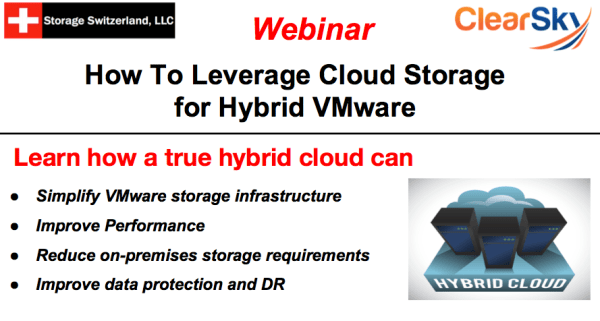
To learn more about creating a Hybrid VMware environment join Storage Switzerland and ClearSky Data on our on demand webinar, “How To Leverage Cloud Storage for Hybrid VMware”.
Watch On Demand

George Crump is the Chief Marketing Officer at VergeIO, the leader in Ultraconverged Infrastructure. Prior to VergeIO he was Chief Product Strategist at StorONE. Before assuming roles with innovative technology vendors, George spent almost 14 years as the founder and lead analyst at Storage Switzerland. In his spare time, he continues to write blogs on Storage Switzerland to educate IT professionals on all aspects of data center storage. He is the primary contributor to Storage Switzerland and is a heavily sought-after public speaker. With over 30 years of experience designing storage solutions for data centers across the US, he has seen the birth of such technologies as RAID, NAS, SAN, Virtualization, Cloud, and Enterprise Flash. Before founding Storage Switzerland, he was CTO at one of the nation's largest storage integrators, where he was in charge of technology testing, integration, and product selection.


 StorageSwiss.com - The Home of Storage Switzerland