
vSAN licensing counts your cores. Then it counts your raw terabytes. The array comes back, and two more vendors come with it.
Hyperconverged infrastructure sold storage buyers one big idea. Retire the array and the array controller, then let software on standard servers hold the data. A decade later a familiar shape shows up in production. The HCI cluster runs the virtual machines. A separate array sits beside it and holds the data that grew. Those teams made a sound call, and vSAN licensing explains most of it.
Key Takeaways
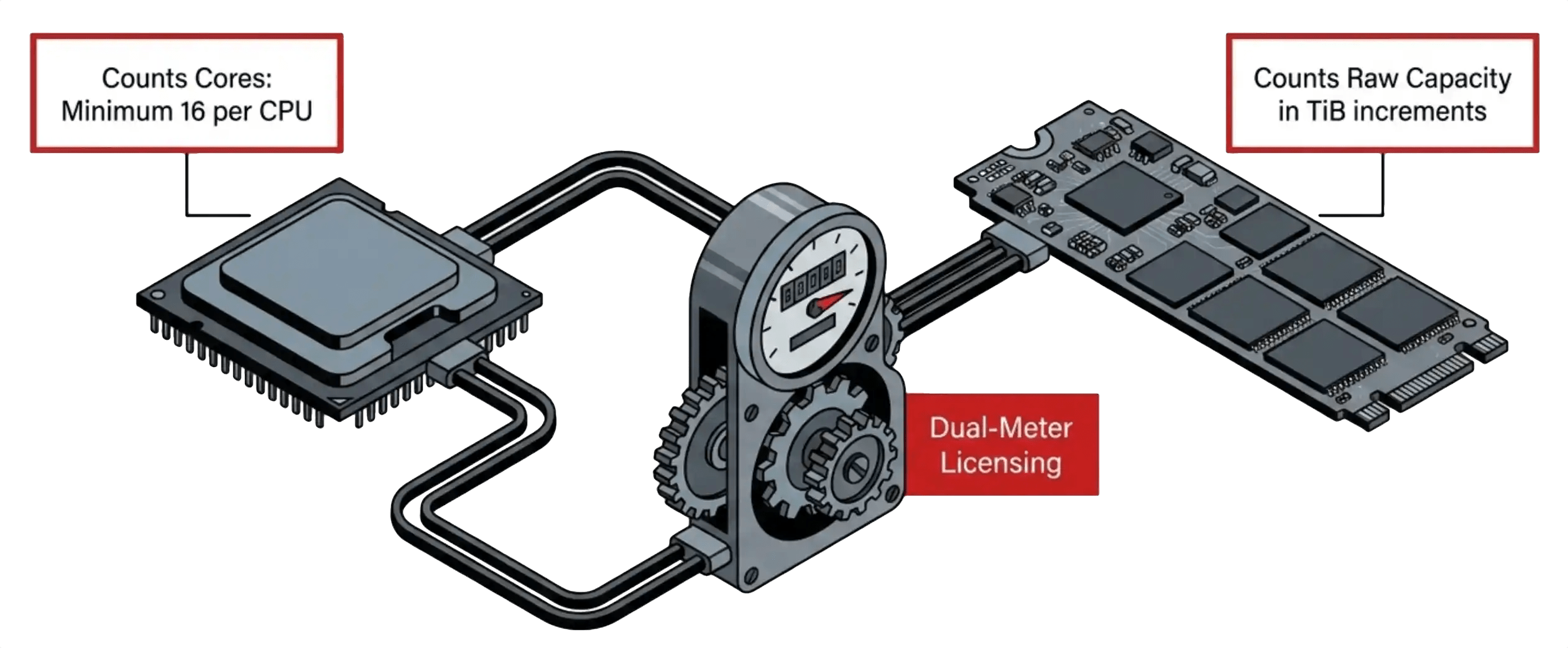
- vSAN licensing runs two meters. One counts cores, with a floor of 16 cores per CPU. The other counts raw terabytes.
- Each licensed core includes raw capacity. VCF includes 1 TiB per core and VVF includes 0.25 TiB per core. Anything past that bills as an add-on license.
- The meter reads raw physical capacity, so deduplication and thin provisioning never lower the licensed number.
- Removing a host shrinks the entitlement, so consolidation can write you a storage bill with no change to your data.
- Capacity-priced arrays win that arithmetic, which rebuilds the three-tier stack the converged purchase was meant to retire.
What vSAN Licensing Actually Meters
Broadcom runs two meters rather than one. The first counts cores, and the second counts raw terabytes.
Key Terms
Raw capacity
The physical capacity of the disks vSAN claims, counted before failure tolerance and before data reduction. This is the number licensing measures.
TiB entitlement
The raw capacity included with each licensed core. VCF includes 1 TiB per core. VVF includes 0.25 TiB per core, rounded up.
Add-on capacity license
A separate license sold in TiB increments, required once raw capacity in the cluster passes the entitlement the licensed cores earned.
Entitlement recalculation
The re-measure of entitlement against consumption. It fires on a license assignment, a host joining, a host leaving, and any change in total raw TiB.
Controller VM
The virtual machine Legacy HCI runs on every node to deliver storage services. It reserves cores and memory on each host before a workload starts.
- Cores. vSAN licenses every core on every host in the vSAN cluster, with a floor of 16 cores per CPU.
- Capacity. Each licensed core carries an entitlement of raw capacity. VCF includes 1 TiB per core. VVF includes 0.25 TiB per core.
- Overage. Raw capacity past the entitlement bills through an add-on license sold in TiB increments.
Broadcom’s own example puts three hosts with two 16-core CPUs each at 96 licensed cores. That earns 96 TiB. Fill those hosts with 100 TiB of raw NVMe and you buy an add-on license for the 4 TiB overage.
The Meter Reads Raw, Not Usable
This detail costs more than the rate does. vSAN licensing measures the raw capacity of the disks it claims. It ignores what you get back after failure tolerance and data reduction. Dedupe and thin provisioning cut what you store. The licensed number stays where the drives put it.
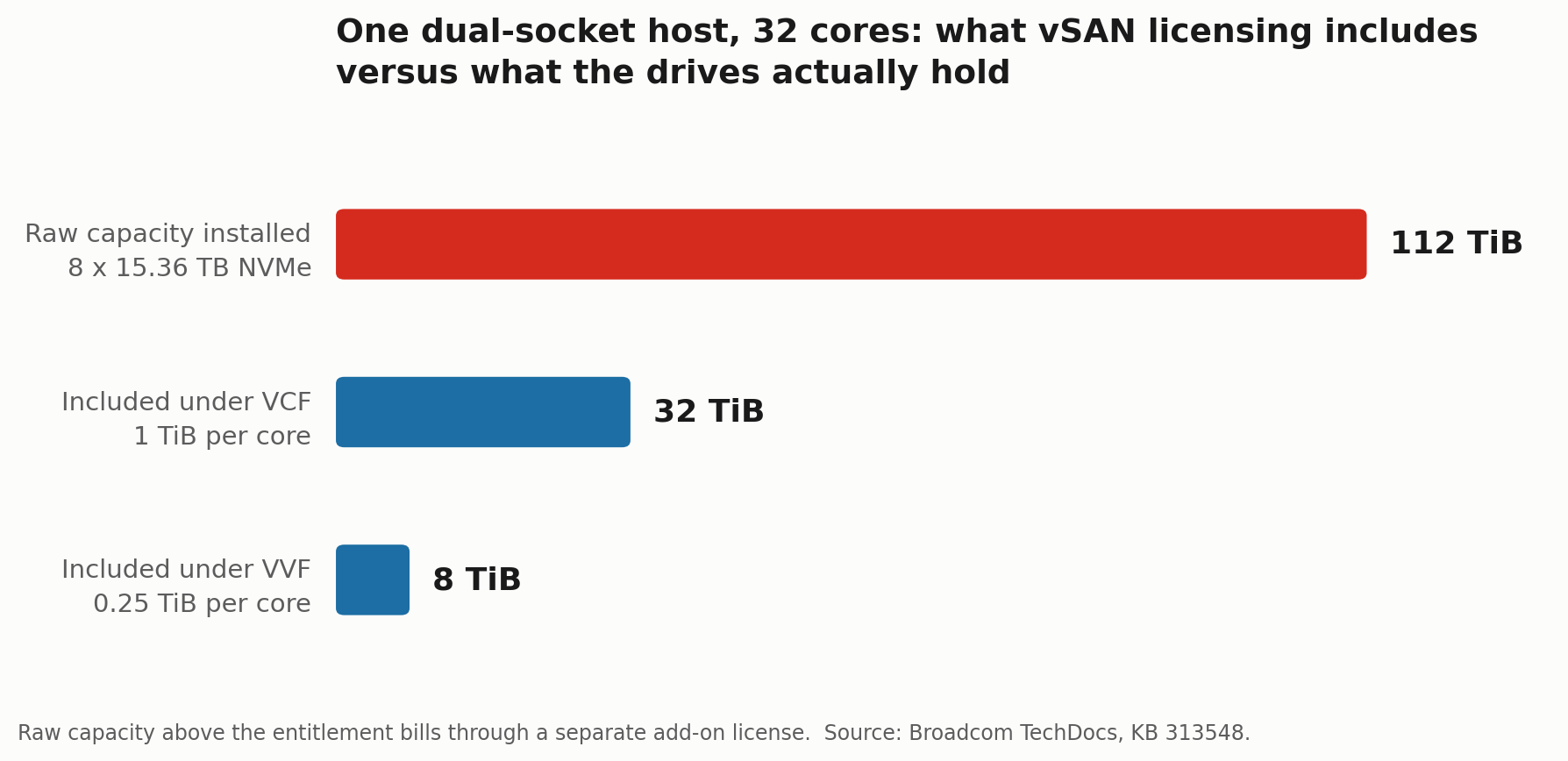
Modern flash blows past the ratio. Look at one dual-socket host with 32 cores.
The VCF entitlement covers under a third of that tray. Under VVF, one drive of that size passes the whole host’s included capacity.
Density lowers your cost per terabyte and raises your license at the same time.
Shrink the Cluster and the Bill Grows
Broadcom recalculates entitlement against consumption at four moments. The list covers a new license assignment, a host joining the cluster, a host leaving it, and any change in total raw TiB.
That third one should worry anyone consolidating. Retire a host and its cores leave with it. The entitlement leaves too. Your data never moved, and the cluster now sits over its included capacity. An add-on license covers the gap. Shrinking the footprint writes you a storage bill.
Growth hits the same wall from the far side. A storage-dense node brings cores nobody will schedule. The entitlement those cores carry falls short of what the drives hold. That node bills you twice.
The Controller VM Charges Its Own Toll
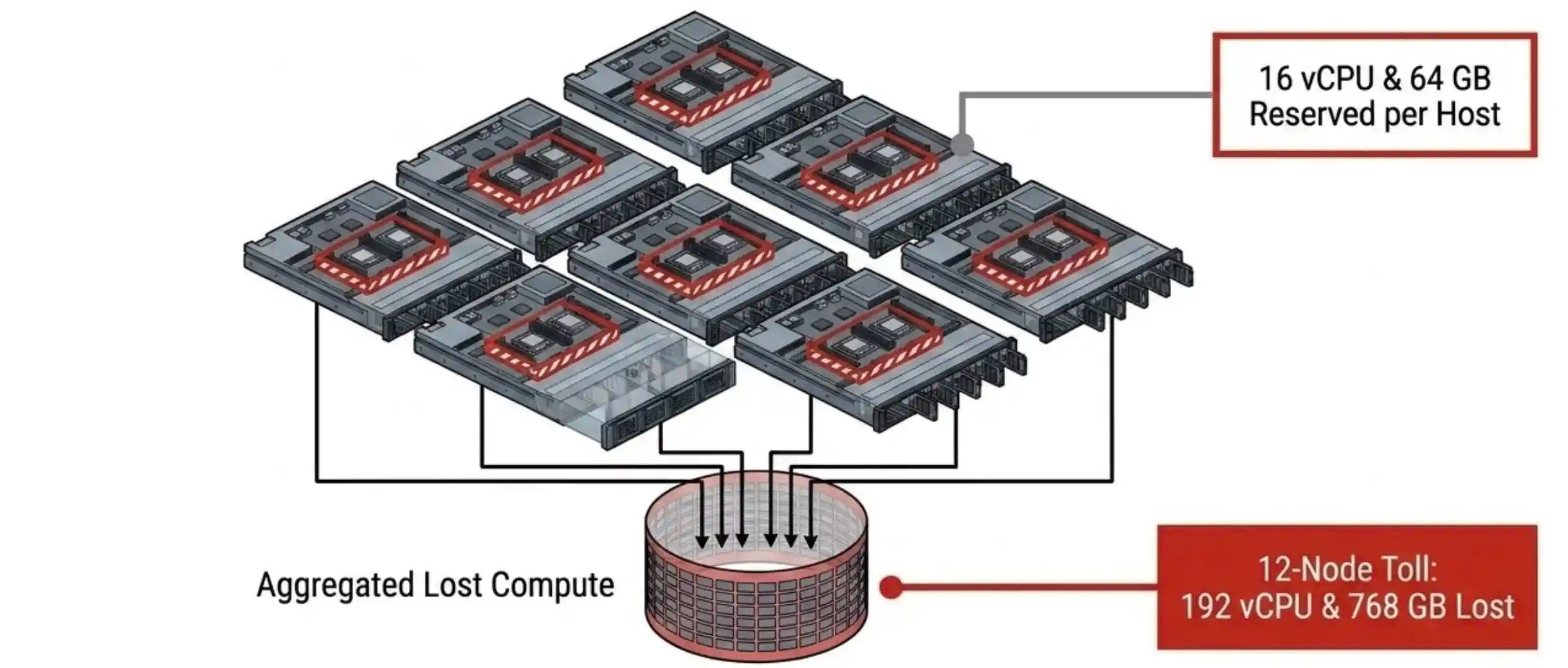
Nutanix reaches the same place by a different road. Its storage runs inside a controller VM on every node, documented at roughly 16 vCPU and 64 GB per host. A twelve-node cluster gives up about 192 vCPU and 768 GB before an app starts. That reservation holds whether the cluster serves 50 TB or 500. Both vendors certify their own hardware, so a compatibility list decides which servers you can buy.
Why the Array Comes Back
External arrays price by usable capacity. That matches how storage teams think about data. Put a capacity-priced array next to a core-and-raw-terabyte meter and the arithmetic picks the array. It is a sound call. It also carries a cost the spreadsheet leaves out.
The storage tier you deleted comes back. It brings its own controller, its own support contract, and its own refresh calendar. The network repeats the pattern. When the software-defined network costs too much or asks too much of your team, the switches and the network vendor stay. The three-tier data center rebuilds itself on the far side of a converged purchase. That outcome should sound familiar to anyone who has weighed turnkey against software-based HCI.
Three Tiers Means Three Masters
Three tiers is a form of lost control, not just an older diagram. Split compute, storage, and network and you get three vendors. Three support contracts. Three refresh calendars, three compatibility lists, and three licensing models. Each vendor works to grow its share of your budget.
The bill for that split comes due during an outage. Three vendors read one another’s logs, and you own an integration nobody else supports. Every upgrade turns into a negotiation across three roadmaps. Your storage team runs a general contract instead of a data platform.
Two Questions That Separate the Platforms
Ask any converged vendor to price two scenarios. First, double the raw capacity and add no compute. Second, pull two hosts out and hold the data flat. A vendor who charges more in either case has tied your storage bill to something other than your data.
Then ask for the ratio in writing. How many raw terabytes does each licensed core carry? What happens at the line? Does the meter read raw or usable? A raw meter means every efficiency feature you paid for stops short of the invoice.
Scaling on the Workload’s Terms
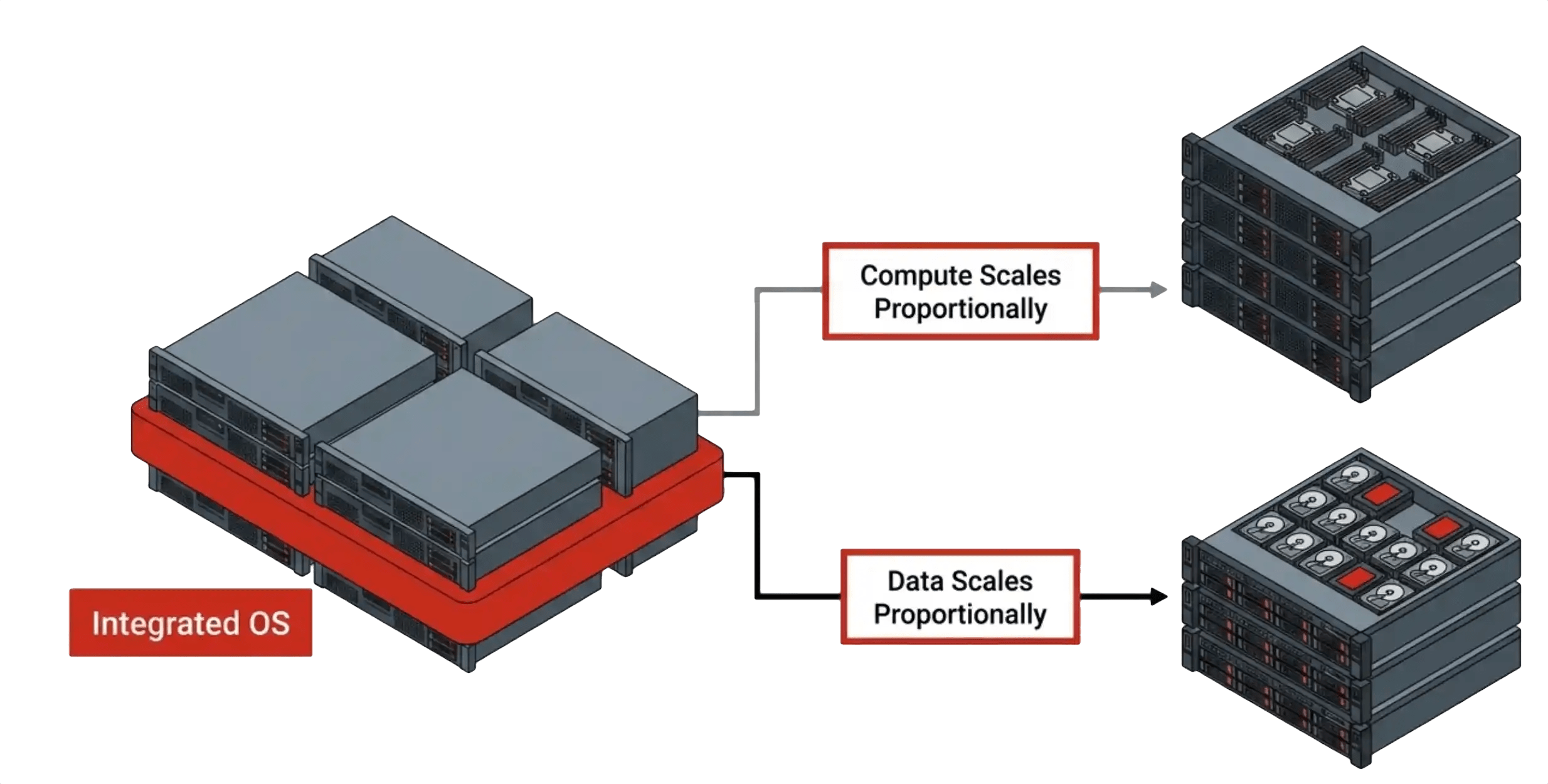
Storage and compute scale on their own when one operating system runs both. VergeOS works that way. Storage services live in the OS instead of a controller VM on every node, so the cores and memory Legacy HCI reserves go back to your workloads. Capacity grows by adding drives or storage-focused nodes on commodity x86. Inline global dedupe and thin provisioning cut the flash you buy in the first place. Hardware choice still matters, and the choice returns to you.
That restores an ordinary expectation. Data growth costs money in proportion to the data. Compute growth costs money in proportion to the compute. You make both calls, and the array stays retired.
Go Deeper
Watch the demos, then read the migration
VergeIO ran a session on how Legacy HCI took control of the data center, and it was mostly live demo. Three of them, on screen. A running VMware virtual machine imported into VergeOS in seconds, with the original retained so a bad import restores and tries again. A live VM moved between nodes from the command line with no interruption, which is the refresh clock handed back. And a batch of new VMs built from a plain-language request, using AI models running locally on the box rather than a cloud service.
Watch the session: Legacy HCI Took Control of Your Data Center (registration includes the on-demand recording)
Case study: Formica standardizes its global infrastructure on VergeOS, replacing VMware and StarWind
vSAN Licensing FAQ
How does vSAN licensing work?
vSAN licenses per core across every host in the vSAN cluster, with a 16-core-per-CPU floor. Each licensed core also carries an entitlement of raw capacity. VCF includes 1 TiB per core and VVF includes 0.25 TiB per core. Raw capacity above that entitlement needs an add-on license.
Does vSAN licensing count usable or raw capacity?
It counts raw. vSAN licensing measures the physical disks the cluster claims, before failure tolerance and before data reduction. Deduplication and compression lower what you store and leave your licensed capacity untouched.
Can removing a host raise my vSAN license cost?
Yes. Entitlement is recalculated when a host leaves the cluster. Those cores took their included terabytes with them. The same data on the same drives can now exceed your entitlement and trigger an add-on license.
Why does dense NVMe cost more under vSAN licensing?
The ratio is fixed per core and modern drives are large. A 32-core host earns 32 TiB under VCF and 8 TiB under VVF. Eight 15.36 TB drives put roughly 112 TiB of raw capacity in that host, so the overage bills separately.
Do hosts outside the vSAN cluster need a vSAN license?
No. The scope is the vSAN cluster. Hosts in other clusters carry no vSAN licensing requirement, though every core on every host inside the vSAN cluster does.

George Crump is the Chief Marketing Officer at VergeIO, the leader in Ultraconverged Infrastructure. Prior to VergeIO he was Chief Product Strategist at StorONE. Before assuming roles with innovative technology vendors, George spent almost 14 years as the founder and lead analyst at Storage Switzerland. In his spare time, he continues to write blogs on Storage Switzerland to educate IT professionals on all aspects of data center storage. He is the primary contributor to Storage Switzerland and is a heavily sought-after public speaker. With over 30 years of experience designing storage solutions for data centers across the US, he has seen the birth of such technologies as RAID, NAS, SAN, Virtualization, Cloud, and Enterprise Flash. Before founding Storage Switzerland, he was CTO at one of the nation's largest storage integrators, where he was in charge of technology testing, integration, and product selection.


 StorageSwiss.com - The Home of Storage Switzerland
Leave a comment